
Introduction
Why your shoulder blade might be the most important part of your throwing motion.
When most quarterbacks think about throwing mechanics, they jump straight to arm slot, hip rotation, or wrist flick. But there’s a major piece of the puzzle that often gets overlooked: The scapula – your shoulder blade.
Extensive research shows that the scapula plays a crucial role in overhead throwing efficiency, arm health, and energy transfer (Kibler et al., 2013; Ludewig & Reynolds, 2009)
Your scapula is like a launchpad for the throw. The way it moves determines how efficiently you load, accelerate, and release the football. When the scapula moves poorly, athletes compensate with the shoulder or elbow, increasing stress and reducing power (Myers et al., 2012).
Video: Kannon Burroughs (2026 D1 commit) on the right, and his SportFX 3D biomechanics model on the left. This comparison shows how his real-time movement translates into measurable mechanics, helping us break down sequencing, loading, and efficiency with precision.
The Six Movements of the Scapula
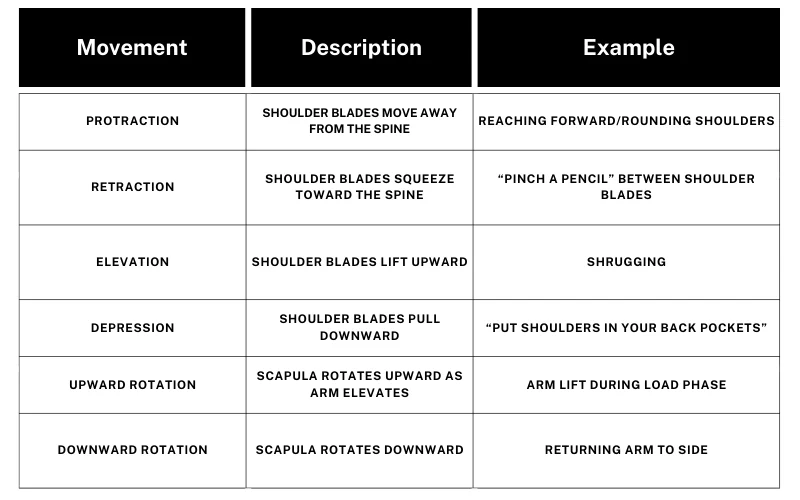
The scapula performs six primary motions, each necessary for healthy overhead mechanics (Ludewig & Reynolds, 2009):

Image: Chart showing the six primary motions of the scapula, with examples (via Ludewig & Reynolds, 2009)
The combination of these motions forms the foundation of the throwing motion and is known as the Scapulothoracic Rhythm, which is essential for efficient shoulder function (McQuade et al., 1995)
Why Scapular Retraction Matters for QBs
Imagine drawing back a bow before firing an arrow. That pull-back is a scapular retraction — the hidden load phase of every powerful throw. Scapular Retraction = The QB’s Load Phase
Scapular retraction is one of the most important and misunderstood elements of a quarterback’s throwing mechanics. Research shows that proper retraction allows the humerus (upper arm bone) to load into external rotation safely and efficiently, improving velocity while reducing joint stress (Oyama, 2012)
When you retract the scapula (pull the shoulder blade back), you:
✔ Create space for the humerus to rotate
✔ Stretch key muscles for stored elastic energy
✔ Improve external rotation of the arm
✔ Reduce stress on the elbow and shoulder
✔ Set up a more efficient kinetic chain — energy from the ground → hips → torso → arm → wrist → ball
Without this retraction, athletes lose the ability to load properly and begin to “muscle the throw,” which decreases efficiency and increases injury risk. What Happens Without Retraction? If your scapula doesn’t retract properly, here’s what usually happens:
❌ Your elbow flies up → stress on UCL
❌ Your arm casts around your body → slower ball
❌ Your trunk stops rotating early → arm has to “save the throw”
❌ You lose power — especially late in games
❌ Velocity drops + inconsistency goes up

Image: Horizontal shoulder abduction increases through the motion and peaks right before release. This is the moment when the scapula is fully loaded and ready to transfer power.
Translation: Bad scap movement = weak mechanics + higher risk of injury.
How Retraction Helps You Throw BETTER

Image: Chart showing how proper shoulder retraction promotes the correct patterns and avoids negative outcomes and overuse injuries.
All of these outcomes match what research and literature identifies as the hallmark differences between high-level throwers and inefficient ones (Seroyer et al., 2010).
Image: The yellow region marks the scapula, the launch point of the throw. When it loads correctly, the rest of the motion follows (via Seroyer et al., 2010).
Simple Cues to Improve Scapular Retraction
Use these during warmups, band work, and throwing sessions:
• “Pull the shoulder blade back, not the elbow up.”
• “Pinch a pencil between your shoulder blades.”
• “Show your jersey number to the sky during load.”
• “Create space — don’t crowd the throw.”
• “Elbow waits — torso goes first.”
Training Scapular Control
You don’t need heavy weight. You need control.
Great drills for QBs:
• Band pull-aparts (slow + controlled)
• Wall slide w/ lift-off
• Prone Y/T/W holds
• Scap push-ups
• Half-kneeling band retractions (“QB load reps”)
The goal here is to create a mental connection between the brain and the muscles to move the scapula before you move the arm.
Utilizing our partnership with SportFX, we have been able to dive into the pool of data they have gathered and the knowledge cultivated. This collective information shows that while Scapular retraction matters, having the ability to allow the scapula to move freely and naturally is just as paramount. These drills help improve mobility and teach the scapula to be comfortable as well as stable in all planes of movement. Essentially, we want Scapular retraction to be natural, not forced
Final Message to QBs
As we continue refining the quarterback throwing motion, it’s important to recognize that true mechanical efficiency is only possible when we can accurately measure how efficiently the body is moving. This is where SportFX fundamentally elevates that process. Their movement-analysis technology allows athletes and coaches to quantify the subtle mechanics that often determine the difference between an efficient kinetic chain and one that relies too heavily on the arm. By capturing real data on scapular retraction quality, trunk sequencing, rotational timing, and compensatory patterns, SportFX gives a level of insight that simply isn’t available through observation alone. These objective metrics help us validate why certain drills work, identify precisely where mechanical breakdowns occur, and create individualized adjustments that improve both performance and long-term durability. In short, SportFX allows us to coach with clarity rather than assumption, ensuring every rep is part of a measurable, evidence-driven progression toward creating a more efficient and resilient quarterback.
The strongest arms don’t come from the arm. They come from how well you control your shoulder blade. Your scapula is the starting point of every throw. Control it → load it → unleash it. That’s where true velocity and efficiency are built. Great quarterbacks don’t just throw with their arm. They throw with their entire body. Starting with the scapula.
References:
Ibler, W. B., Ludewig, P. M., McClure, P. W., Uhl, T. L., & Sciascia, A. (2013). Scapular dyskinesis and its relation to shoulder pain. Journal of the American Academy of Orthopaedic Surgeons, 21(6), 364–372. https://doi.org/10.5435/JAAOS-21-06-364
Myers, J. B., Oyama, S., & Wassinger, C. A. (2012). Scapular dysfunction in high school baseball players sustaining throwing-related upper extremity injury. Journal of Sport Rehabilitation, 21(1), 51–56. https://doi.org/10.1123/jsr.21.1.51
Oyama, S. (2012). Scapular retraction and its role in overhead throwing mechanics. International Journal of Sports Physical Therapy, 7(5), 541–546
The post The Scapula: The Hidden Key to Better Throwing Power appeared first on SimpliFaster.
