
A series of new regulations following the government’s issuance of Decree No.15/2025/ND-CP, which took effect in early 2025, have expanded the legal framework, granting Vietnam Railways (VNR) greater autonomy.
In late September, VNR issued Document No.3587/DS-TCKT, requesting the Ministry of Construction (MoC) to consider transferring five railway stations including Haiphong, Thanh Hoa, Vinh, Hue and Saigon, alongside the Dalat–Trai Mat railway line to VNR, with the assets to be recognised as part of the state capital invested in the enterprise.
This provides the basis for VNR to finalise its charter capital increase plan for approval by the Ministry of Finance (MoF).
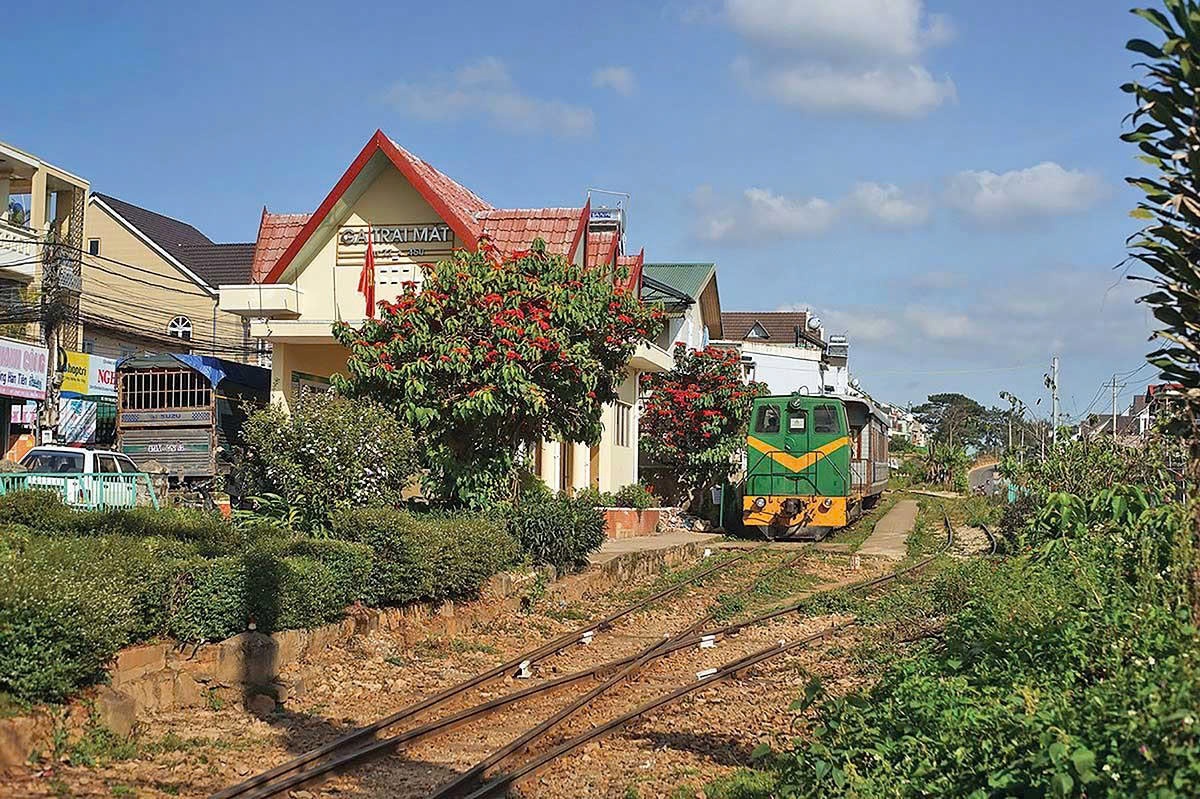
The Dalat–Trai Mat railway line. Photo: baodautu.vn
The assets proposed for transfer cover approximately 396,000 square metres, including 124,000sq.m of railway land (31 per cent) and 40,000sq.m of station platforms (10 per cent). Around 187,000sq.m, or 47 per cent of the total, is available for commercial use, with the remainder comprising other types of land.
VNR estimates the value of the assets at approximately $13.5 million. The official value will be determined by a professional valuation firm and subsequently submitted to the MoC for review and final decision.
The transfer of the aforementioned assets, with their value recognised as part of the state capital invested in the enterprise, could mark a major shift for VNR and in the overall management and utilisation of Vietnam’s national railway infrastructure.
Due to historical circumstances, most railway infrastructure assets are state-owned and managed by specialised authorities, which are also responsible for allocating investment capital for upgrades and maintenance.
VNR operates railway infrastructure through an asset-leasing mechanism, while carrying out management and maintenance tasks commissioned by the state.
VNR has repeatedly argued that state control over infrastructure assets limits its autonomy in investment planning, particularly for upgrading stations, warehouses and service facilities.
“We might appear to be a large corporation, but our only assets are the trains themselves. All railway infrastructure, from tracks to stations and warehouses, belongs to the government. We need approval for almost everything,” a VNR executive said in a recent talk to VIR.
The annual budget for railway infrastructure maintenance currently stands at about $116 million, equivalent to approximately 38 per cent of actual requirements.
After prioritising railway safety and mainline infrastructure maintenance, only $800,000 to $1.2 million remains annually for station and freight yard upgrades. Meanwhile, the state collects just $11.6 to $15.4 million a year in infrastructure leasing fees.
As a result, many stations and freight yards across the national railway network remain outdated and deteriorating, while demands for better service quality and commercial utilisation continue to grow.
The changes to the management, use and utilisation of railway infrastructure assets provide a basis for addressing these longstanding issues.
The foremost requirement is that the asset transfer be accompanied by an approved charter capital increase plan, the owner’s representative agency’s opinion, an asset list, legal documents, and several relevant details.
“Therefore, to ensure feasibility and alignment before committing time and resources to finalising the detailed proposal for submission to the MoF, VNR needs the MoC’s in-principle approval at the planning stage,” the VNR executive explained.
In the future, VNR may propose transferring other national railway infrastructure assets under the state-capital recognition mechanism, in line with its business needs and strategic direction.
“This will give VNR greater flexibility in mobilising investment resources to upgrade and better utilise its assets, improving passenger services and business performance,” the VNR executive said.
Specific financial mechanism proposed for Vietnam Railways
The Ministry of Finance is drafting a decree on the operational and financial management mechanism for Vietnam Railways to create a legal basis for state capital investment and management.
Online rail ticket demand highlights growing role of trusted digital channels
Rising online demand for Vietnam Railways tickets is bringing more first-time travellers into digital booking, while highlighting the growing importance of trusted distribution channels, transparent payments and post-purchase support.
Vietnam seeks railway partners at InnoTrans 2026 in Berlin
A delegation from the Ministry of Construction, led by Deputy Minister Bui Xuan Dung, attended InnoTrans 2026 in Berlin to promote cooperation and technology transfer for the North-South high-speed railway project.
Private funding offer opens new path for Vietnam’s rail sector
A private company’s proactive offer to fund the planning of the My Thuy–Lao Bao railway has opened up a new approach to mobilising private resources for a sector that has long been heavily dependent on state budget funding.
