
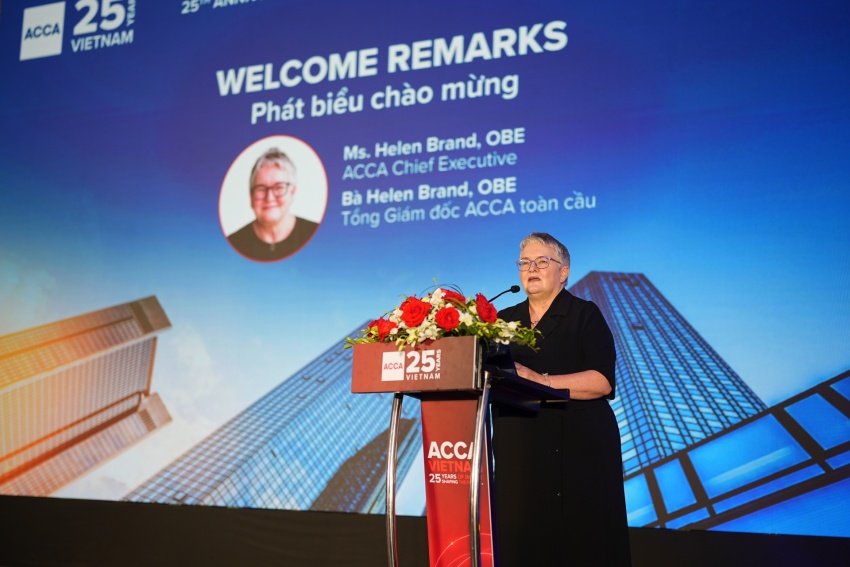
On September 14, as part of ACCA Vietnam’s 25th anniversary celebration, a high-level forum was held in Hanoi on ‘Trust and Transparency’ for Vietnam’s International Financial Centre (VIFC).
Helen Brand, ACCA’s chief executive said that VIFC has the potential to become a vital platform connecting the country’s investment needs with international pools of sustainable capital.
“We strongly support the development of high-quality international sustainability reporting standards, including the work of the International Sustainability Standards Board,” she said. “These standards create a common language among businesses, investors, regulators and financial institutions. They make information more comparable and consistent, improve decision-making and, most importantly, build the confidence on which sustainable finance depends.”
The development of VIFC therefore gives Vietnam an important opportunity to embed these principles from the outset, according to ACCA’s chief executive. By placing these qualities at the centre of its activities and building its strategy and operations around transparency and trust, VIFC can position itself as a respected and valued partner for international investors.
“This requires a strong legal and regulatory foundation, effective governance and risk management, high-quality financial and sustainability information, and professionals with the skills and ethical judgement needed to make the system work,” she added. “This is where the accountancy profession is irreplaceable.”
ACCA expressed commitment to supporting Vietnam in widening and deepening its talent pool of highly educated, well-trained, and ethically motivated professional accountants, while developing the skills and knowledge base needed for the next stage of the country’s economic expansion.
Helen Brand, chief executive, ACCA. Photo: ACCA Vietnam
Dinh Hong Hanh, partner, financial services leader, PwC Vietnam, identified three key issues related to investor access to and confidence in the VIFC.
The first is policy predictability, which requires a stable, structured, and consistent system of regulations and guidance.
“This is vital because investors need to clearly understand the framework to make decisions, as well as the requirements involved in implementing those decisions and realising the benefits from their investments,” said Hanh
The second factor is the ability of VIFC members to build reliable information, starting with the financial reporting standards framework.
VIFC regulations allow the full and unmodified use of International Financial Reporting Standards. Hanh noted that this was a new decision issued by the Ministry of Finance in August and also supports the comprehensive financial market reform scheme issued by the government in July.
“These are very encouraging steps. When international financial reporting standards are applied consistently, the ability to reconcile and compare the financial statements of members within the international financial centre with one another, as well as with other components of the Centre, will be enhanced,” Hanh said.
Beyond financial reporting, the reliability of information is also reflected in reporting related to green finance. Vietnam issued its Green Taxonomy in 2025, providing a basis for classifying projects according to a specific set of criteria.
“The next important issue is how to develop the reporting framework and establish assurance mechanisms for those reports, thereby making financial information more reliable. I believe these are critical areas that need to be further developed,” she said.
Photo: ACCA Vietnam
Tran Minh Hoang, relationship manager – Financial Institutions at VPBank, said VIFC’s role should not stop at creating another framework or additional procedures for financial institutions.
“We hope that VIFC will not become an institution that simply creates additional administrative procedures for banks, but instead provides practical mechanisms to help banks scale up capital raising and, in turn, continue supporting the economy,” Hoang said. “In the short term, VIFC should first focus on standardising and aligning Vietnam’s Green Taxonomy framework with international green principles and standards.”
Hoang said that before Vietnam issued its green classification framework, many banks had proactively developed their own Green Frameworks and complied with the international principles and standards of the International Capital Market Association or the Loan Market Association to access international capital. Vietnam also issued its set of green standards in 2025.
In his view, rather than creating another set of criteria, the key is to ensure compatibility between Vietnam’s criteria and international principles.
“The important thing is to align Vietnam’s criteria with international green principles and standards. This would mean that companies and banks would not have to repeatedly work with or explain to international lenders that Vietnamese assets are recognised and have been standardised in line with international principles,” he said. “Such alignment could help reduce the need to re-verify or adjust portfolios when companies and banks seek international funding.”
However, according to Hoang, establishing a set of principles is only the first step. The next challenge is how companies can meet and maintain those criteria throughout the life of a loan or investment.
International principles generally provide an overarching framework, while specific assessment criteria and thresholds are established by individual countries to reflect their own circumstances. Therefore, alongside developing the framework, VIFC needs to support banks and companies in establishing effective measurement, reporting, and verification (MRV) mechanisms.
“When investors come here and provide a 10-15-year loan or invest in a bond with a 10–15-year tenor, they can assess a company against individual criteria at a given time. But they will also require the company or bank to demonstrate that those criteria can be monitored, assessed and maintained throughout the life of the loan,” Hoang said. “Therefore, a clear and seamless MRV mechanism extending from the leadership level, together with a standardised system, would create opportunities for us to mobilise international capital.”
Green finance talent a must for new IFCs
The development of international financial centres in Vietnam has been designed by the government around several core pillars, among which the international factor plays a decisive role in ensuring the safe operation of the entire financial system.
Developing suitable talent for greener financial ambitions
Vietnam’s ambition to develop international financial centres is sharpening the focus on talent capable of navigating sustainable finance and evolving standards. To Quoc Hung, country manager of ACCA Vietnam, spoke with VIR’s Khanh Linh about how the country can strengthen its green finance talent pipeline.
ACCA marks 25 years in Vietnam
Marking 25 years in Vietnam, ACCA is looking beyond a quarter-century of building the professional community to help shape the finance and accounting workforce needed for the country’s next phase of economic development.
