
(Re)imagining Cluster Sets in Strength and Conditioning
Cluster sets are an advanced training method in weightlifting that have (re)gained popularity among strength and conditioning professionals for their ability to enhance performance, power, and muscular endurance. Once popular in the powerlifting world for decades, it has moved into the performance space in recent times with different variations. Unlike traditional straight sets, where all repetitions are performed consecutively to achieve a certain number of reps, cluster sets introduce shorter rest intervals between smaller groups of repetitions within a single set. This simple but effective modification allows for partial recovery, enabling athletes to lift heavier loads, sustain bar speed, and maintain proper technique throughout the entire set. As a result, cluster sets offer a strategic balance between intensity and recovery, making them a valuable tool for both strength and power development. We refer to this as maintaining quality. Our classic example of using a small group of guys. One week they did 3×10 at .8-.9 m/s. Out of the 30 reps, 24% were outside of that range. Due to a multitude of reasons; most commonly fatigue, lack of effort, lack of attention to detail, or saving gas early in the set to finish the set. Especially with the addition of velocity based training technology, this gives an ideal opportunity to really emphasize and deliver on a desired outcome. Another evolution of these are in group training where the exercise that is being “clustered” is super-setted with an accessory exercise and implemented on a large scale in team settings. I think this is the direction my thought process, this article, and the future of cluster set training are going – evolving in front of our eyes.
Philosophical Implementation
I describe this as the deliverable(s). What are you designing to implement or deliver to the population you are working on to accomplish a goal or mission in other words. In our case it’s to maximize performance while minimizing time-loss injuries. The fundamental concept behind cluster sets lies in manipulating intra-set rest periods. For example, instead of performing 6-12 repetitions continuously at a certain percent of one’s one-repetition maximum (1RM) for 3 sets to get a total volume of 18-36 reps to get a desired outcome, an athlete might complete two repetitions, rest for 2-5 minutes, or do an auxiliary exercise, perform two more, rest or auxiliary exercise again, and so on until they finish with a final pair of repetitions.

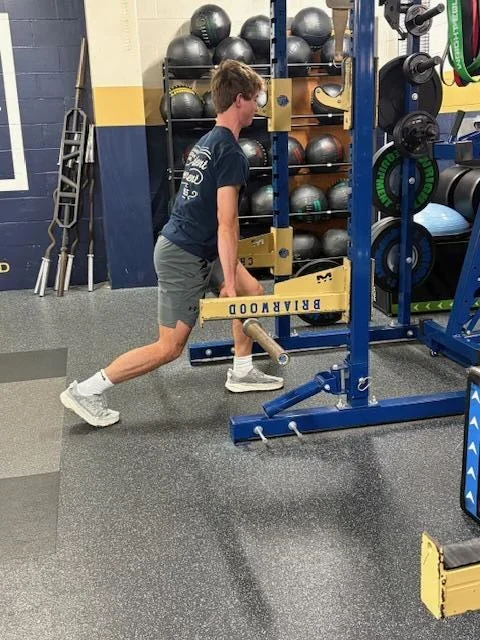
Image: I’ve grown very fond of super setting maximal effort isometrics with the clustered exercise. Above we see a lunge isometric. Below we see a Isometric Mid-Thigh Pull utilizing VALD Force Decks.
Although the total volume remains the same, these shorter rest periods allow the lifter to recover just enough to maintain higher performance on each mini-cluster. Or it allows them to work on other muscle groups in an efficient and effective fashion. This structure enhances neuromuscular efficiency, bar speed or power production, and ultimately overall training quality. Because fatigue is slightly reduced between clusters, the athlete can perform more work at higher intensities compared to traditional methods while having the same volume. We take this a step further and use a superset structure. We operate in 2 week microcycles that we call “Heavy Doubles,” and “Heavy Triples” See the table below for an example of how we program out cluster sets in a 2 week microcycle.

Chart: This chart lays out what a typical week of training looks like, and how one week is progressed to the next using a clustered VBT approach.
We then alter the velocity (therefore load) and volume the next 2 week cycle. We do this for 8-12 week blocks then program a deload or competition week before moving to the next cluster block. You can also adjust rest time between sets to creep into different energy systems and to get different physiological adaptations, if desired. Here is what a specific daily program example for us looks like:

Chart: This chart lays out how you can program multiple different auxiliary exercises as supersets across 12 total sets of a main lift, in this case, the back squat.
The benefits of cluster sets are diverse and highly dependent on training goals. For athletes focused on maximal strength, cluster training provides a method to sustain heavy lifting intensity while avoiding premature fatigue. For power development, it allows lifters to produce high velocity movements under load, improving rate of force development. Additionally, for hypertrophy-oriented programs, clusters extend time under tension and total volume, contributing to muscle growth while managing fatigue. Overall, cluster sets enhance strength, power, endurance, and technique, all while supporting efficient recovery within and between sets optimizing outcomes.
Cluster sets enhance strength, power, endurance, and technique, all while supporting efficient recovery within and between sets optimizing outcomes, says @KyleSouthall1
Share on X
Integrating Velocity Based Training Technology
Velocity based training (VBT) technology is very helpful for what we do and especially in our developing clients and athletes. Over time I have learned that it is even more so by integrating cluster sets. This allows the athlete real time feedback on effort and performance. They know literally by the rep if they need to adjust weight to achieve, or maintain, a velocity goal. We can really dial in and our long time users have really gotten trained here. We had an athlete who over 4 weeks was prescribed 138 cluster set reps (Week 1 10×2, Week 2 12×3, Week 3 10×2, and Week 4 12×3) of back squat at .6m/s. Of those 138 reps, 121 of them were .6 +/- .05 m/s. That is quality reps, and really impressive out of an 18 year old! It also allows us to track reps, programming by muscle group in respect to volume, tonnage, and hitting ranges accurately, we call it being able to correct online during a cluster set. See the number if you are high on the range on consecutive sets, add a little weight, if you are low on consecutive sets, take off a little weight.
Cluster Sets for Strength
When training specifically for strength, cluster sets can be performed with loads ranging from 85 to 90 percent of one’s maximum. For us, we program to where the load they work at is .3-.4 m/s since we do not do 1RM or base our programming off %1RM. This approach allows lifters to maintain high force output and technical precision, even under very heavy loads. It is particularly effective for compound lifts such as squats, deadlifts, and bench presses, where form and stability are critical to performance and safety. We program bench press and back squat for these.

Image: One thing we do is vary the exercise slightly every so often. Here is a normal back squat using Vitruve VBT to look at both eccentric and concentric phases of the squat and utilizing those as parameters.
Cluster Sets for Power
For power development, the emphasis shifts from maximum load to explosive movement. A cluster structure for these looks more into rate of force development and we program a wider range of velocities compared to absolute strength. Our usual ranges here are .6-1.0 depending on the exercise. Occasionally we do traditional powerlifts up to 1.2-1.4 or so, but that is rare, since olympic lifts are rare in our programming. We do teach the lifts and movements, but utilize them rarely long term. Exercises like the power clean and its variations, or push press benefit greatly from this method, as the brief rest intervals prevent excessive fatigue from reducing power output between reps or sets.

Image: We also have gotten to like maximal effort plyometrics as supersets for our clustered exercises. Here you see a countermovement jump on our VALD Force Decks.
Cluster Sets for Hypertrophy
When the goal is hypertrophy, cluster sets can be performed at moderate intensities—around .6-.8 m/s but ultimately comes down to rep totals. For example we still get to the 30-36 rep range but do so with less sets which can promote muscle growth while minimizing the drop in performance typically seen in high-rep traditional sets. So if you are a math person and you saw above that we program 12×3 for strength, and program 8×4 here you may be saying that math doesn’t math. My response to this is that compared to traditional belief, I believe you can get stronger and hypertrophy and you can get more powerful and hypertrophy. You can be exposed to very high loads for a longer period of time (per repetition) and still hypertrophy. Cluster sets are the connection between the two traditionally separated concepts.
Time Under Tension
Time under tension (TUT) is exactly that – the time that the musculotendinous unit is under tension. This ties in almost directly to Davis’ Law of Physiology as soft tissues, most namely in this instance muscles and tendons, but also to an indirect extent ligaments and fascia will adapt based on the stresses placed upon it. Given the assumption that proper rest, hydration, and nutrition is provided. TUT can be hugely applicable in many cases ranging from exposure to high intensity eccentric forces to get past a tendinopathy (most commonly large tendonitis), to tissue acclimation in youth or under developed tendons. This is our philosophy using cluster sets also. We can expose our athletes to higher tensions and forces with more time to acclimate between which increases the soft tissue responses in both hypertrophy and neural efficiency. A positive bonus on this is we also get into Wolff’s Law of Physiology and get responses of the skeletal system as well. Again, assuming proper nutrition and time to acclimate between stresses. What’s best about both of these is that they are scalable. We can apply a low level to youth or under-trained, or more to more advanced and higher trained, then lower again for those who may be overtrained. Cluster sets allow us to do this with the ethos of minimal dose to achieve optimal response. Instead of putting medium weight based on a dynamic 1RM that is done with waning effort we can give them a very high weight in short clusters to get specific goals measured via VBT.
Instead of putting medium weight based on a dynamic 1RM that is done with waning effort we can give them a very high weight in short clusters to get specific goals measured via VBT, says @KyleSouthall1
Share on X
Practical Application and Training Tips
Implementing cluster sets effectively requires discipline and precision. Timers should be used to maintain consistent rest intervals, as excessively long breaks may reduce the training stimulus, while too little rest can lead to excessive fatigue. Maintaining proper form and bar speed is essential; if technique begins to degrade, the load should be reduced. Cluster sets are best suited for intermediate to advanced lifters who already possess solid technical skills and training experience, as the higher intensities and rest management demand focused execution.
Cluster Sets Role in Rehabilitation
I get this one a lot, and from all angles. This ranges from cluster sets are for powerlifters trying to be as strong as possible to injured athletes shouldn’t be in the weightroom taking time and space from the healthy athletes – they should be in the athletic training room rehabbing. I also get the opposite in that coaches want them in lifting but they feel that it is out of their scope of practice, or at minimum comfort zone. My immediate answer is most certainly – get them in the weightroom early and cluster sets programmed at proper intensity is perfectly safe once they can safely perform the movements. We have anterior cruciate ligament reconstruction patients starting bench press cluster sets within days of surgery and starting back squat clusters as early as 12-14 days post op. Once they have good quad control and enough range of motion, let’s get their quad activated! Also I cannot speak enough about the psychological aspect of getting back with their team and in the weightroom environment, as long as that is what they are looking for. My first piece of advice for any strength and conditioning coach is develop a good (at least working) relationship with your sports medicine staff. Too many times I see a clash, usually between personality types, between sports medicine and strength and conditioning. It absolutely does not have to be that way. You share a mission and vision, and a role to support student-athletes and coaches. Put away the ego and keep the real things real – work together to take care of and mentor these kids. Be the role model you needed as a youth – communication and working together to accomplish optimal outcomes is a major part of that.
We have anterior cruciate ligament reconstruction patients starting bench press cluster sets within days of surgery and starting back squat clusters as early as 12-14 days post op, says @KyleSouthall1
Share on X
Image: Starting Cluster Sets early in the rehabilitation process. Here we have an athlete who is 6 days post-op starting with light resistance. The key here is get involved with your medical staff early and incorporate safety while allowing them to safety integrate back into the team setting.
What We Learned Working Through the Implementation of Cluster Sets
Just like any other implementation or programming shift there are its growing pains. The key is identifying the risk-benefit ratio. For us with 16 racks working with individual or small groups (less than 10 athletes) was no problem at all and especially with the timing feature of Vitruve it actually sped up workouts. For larger groups it can become more challenging and the transition should have a long runway in a sense of implementation over time. I implemented it with a group of 24 with about a 4 week transition with no problem. The level of training of the athlete also helps. It is harder to teach while keeping track of time and working through sets to keep on task. If possible I recommend separating less trained athletes into a group and more trained into another. This way the ones that are more trained can get to work and keep the temp and intensity high without sacrificing quality. The lesser trained the athlete is, you have a better opportunity to mentor and educate without detracting from higher trained athletes. Another thing we learned is that groups of 3 are perfect for this. 1 does the cluster set lift, 1 does the auxiliary lift, and 1 spots / recovers. This keeps things on schedule and trains the appropriate energy systems equally between lifters. Specifically in the rehabilitation setting we have all our anterior cruciate ligament reconstruction patients start cluster setting bench press in the 2nd week post-op and starting squatting variations between weeks 3-5 depending on their progress. Our initial case report at his end testing just before his Biodex Test to seek return to play clearance from his physician, he increased his 1RM by 95 lbs (29%) and his 3RM by 115 lbs (36%) compared to his best personal record pre-injury with 13 weeks of consistent cluster setting in adjunct to his normal rehabilitation. We have two other ACL patients and both are off to clinically excellent results. As this article is being written one of the two is a female soccer athlete with three years of varsity experience on the field and in the weightroom and is using 10-25lbs over her previous 1RM as sets of 3 in her 4th month post-op.
Conclusion
In conclusion, cluster sets represent a sophisticated and effective approach to resistance training that bridges the gap between strength, power, and hypertrophy development. By strategically integrating short rest intervals within a set, athletes can train with higher quality repetitions, manage fatigue, and achieve specific performance outcomes. Whether the goal is to lift heavier, move faster, become more powerful, or build more muscle, cluster sets provide a scientifically grounded and practical method for enhancing results in the weight room. For serious lifters and coaches alike, mastering the use of cluster sets can unlock new levels of efficiency and progress in strength training and rehabilitation leading into performance training.
The post The Role of Cluster Sets in Strength Training appeared first on SimpliFaster.
