
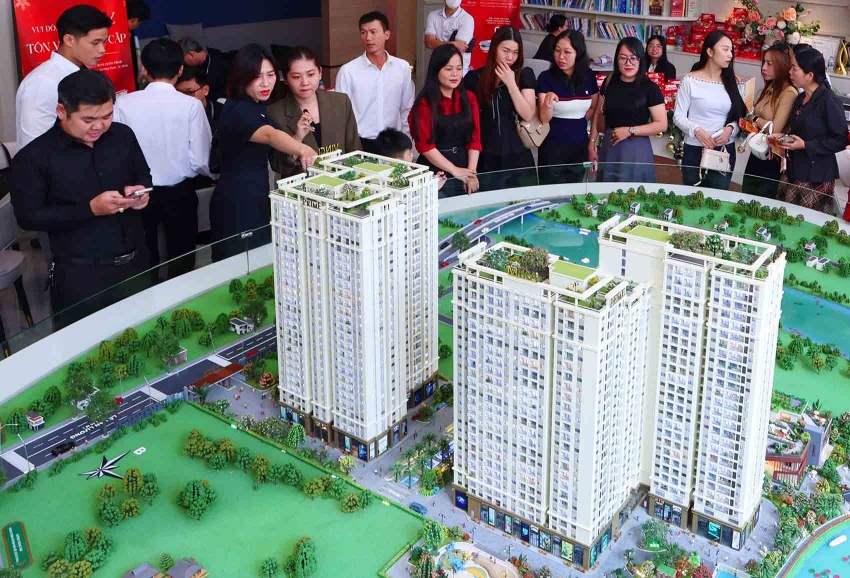
HoREA proposes more affordable housing. Photo: Le Toan
One of the key proposals is to introduce a mechanism for developing affordable commercial housing for middle- and low-income earners in urban areas – a group that does not qualify for social housing but cannot afford higher-priced homes.
Prices for this segment could range from VND25-30 million ($960-1,150) per square metre in provinces to around VND60-70 million ($2,300-2,690) per sq.m in major cities.
These projects would be eligible for incentives in planning, investment procedures, technical infrastructure support, and preferential credit policies for both developers and homebuyers.
For rental housing, HoREA proposed removing the stringent requirement that applicants must be “facing housing difficulties” and instead requiring only that they “have a need to rent.”
The association also called for provincial-level authorities to establish maximum rental price frameworks to ensure the policy is practical and implementable.
in early September, HoREA also proposed the development of a “reasonably priced commercial housing” segment, under which developers would be free to determine selling prices and profit margins, provided they do not exceed price ceilings set by local authorities.
A notable aspect of the proposal is its approach to price determination. HoREA chairman Le Hoang Chau argued that the state should not impose a maximum profit margin on businesses. Instead, developers should be allowed to calculate their costs and profits and determine selling prices, provided these do not exceed the maximum prices for outright sales, instalment sales and rentals set by local authorities.
According to Chau, reasonably priced commercial housing is, by nature, still commercial housing and therefore should not be subject to a maximum profit margin in the same way as social housing.
“We propose that the Housing Law should only establish the principle of a price ceiling, while provincial-level people’s committees would set the maximum prices for outright sales, instalment sales and rentals. They could even set different price ceilings for different areas to reflect local housing price levels,” Chau said.
Chau said businesses have different management capabilities, sources of capital and input costs.
“Some companies may use less financial leverage or have access to more favourable material supplies, allowing them to lower costs while still maintaining profits, while others may need to generate cash flow quickly and accept lower profit margins. Therefore, the state should regulate the final selling price rather than capping profit margins,” he added.
The proposal comes amid a prolonged imbalance in Ho Chi Minh City’s housing supply, which has been heavily skewed towards the high-end segment.
According to data compiled by HoREA, in 2021-2024, the city’s market recorded no reasonably priced commercial housing units being launched. Since then, high-end housing accounted for all of the commercial housing supply eligible for capital mobilisation in the area.
A report released in late August by One Mount Group, a real estate brokerage company, highlights the widening gap between housing prices and buyers’ affordability.
Projects priced at $2,300-4,600 per sq.m accounted for more than half of total transactions, with an absorption rate of around 59 per cent. Meanwhile, the ultra-luxury segment, with prices exceeding $4,600 per sq.m, has seen subdued market activity, with a sluggish absorption rate of only around 20 per cent.
Real estate developers are beginning to turn their investments into affordable housing offerings. Dong Nai Waterfront City, the developer of social housing apartments within the Dong Nai Waterfront development, said it will begin accepting applications to purchase nearly 420 social housing apartments in the fourth quarter.
The apartments are located in the township in Long Hung Ward of Dong Nai City. The venture comprises two 10-storey apartment blocks and expected to be completed by the end of October 2027, with units ranging from approximately 40-80 sq.m in floor area. The indicative selling price is $885-960 per sq.m, inclusive of VAT but excluding maintenance fees.
If implemented on schedule, the project will add to the supply of housing for low-income earners, contributing to Dong Nai’s target of developing 65,000 social housing units in the city by 2030.
In Di An, now part of greater Ho Chi Minh City, Bcons Group continues to target young families and first-time homebuyers with Bcons Centre City, a 3-hectare development planned around an affordable housing concept.
With the mock-up apartment opening last week, the venture, comprising 2,820 apartments and targeting genuine housing demand among urban residents, is expected to be priced at around $96,000 per two-bedroom unit. The first residents are expected to receive their homes in 2028.
Nguyen Quoc Hiep, chairman of the Vietnam Association of Construction Contractors, said businesses fully recognise the significant potential of the affordable housing segment. However, the development of reasonably priced commercial housing is currently facing considerable barriers as input costs have risen sharply.
According to Hiep, land prices, land use fees, construction materials, labour costs, and financing pressures have all increased significantly in recent years. Meanwhile, to keep products within the reach of homebuyers, developers have to maintain reasonable selling prices, leaving increasingly limited room for profit.
“Businesses want to develop reasonably priced housing, but with the current cost base, it is very difficult to ensure investment efficiency. If selling prices are set too low, profitability cannot be secured, while raising prices would make the products unaffordable for the target customer group,” Hiep said at the Vietnam Real Estate Forum in June in Hanoi. “Notably, the segment with the strongest demand in the market is not necessarily the one offering the most attractive investment returns. While high-end projects can generate wider profit margins, affordable housing requires developers to keep costs under tight control while still ensuring quality, infrastructure and amenities.”
Affordability and sustainability to define new real estate cycle
In the new real estate cycle, success will favour developers who prioritise genuine affordability and sustainable financial structures over short-term sales tactics, according to Jerry Nguyen, deputy general director of Investment and International Market Development at Hoa Binh Construction Group.
Tighter bank financing to drive divergence in housing supply mix
Stricter bank lending conditions in 2026 are expected to widen disparities in housing supply mix, financing structures, and credit profile of developers.
Ministry of Construction proposes $400 million for social housing development
The Ministry of Construction is working alongside the Ministry of Finance to propose a capital injection of $400 million for the Central Housing Fund as part of the medium-term social housing development plan for 2026-2030.
