
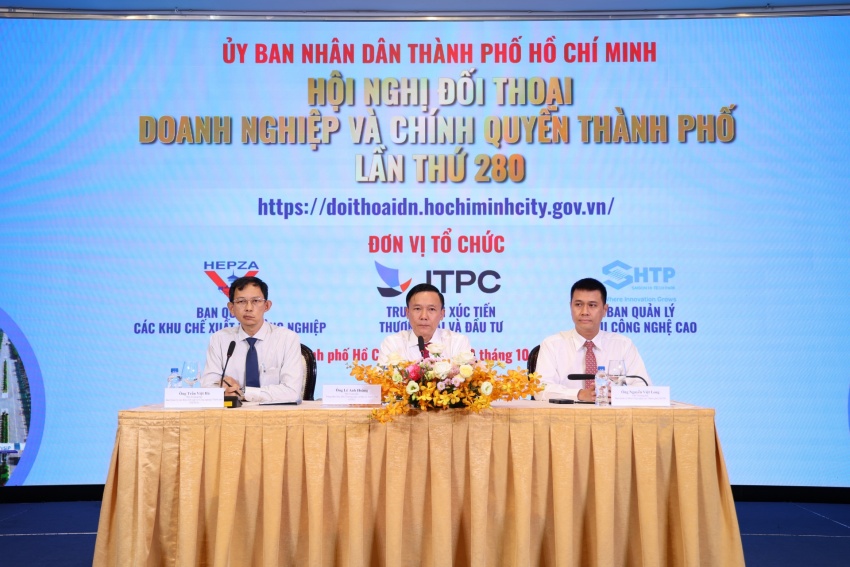
The dialogue was organised by Ho Chi Minh City Investment and Trade Promotion Centre (ITPC), in coordination with Ho Chi Minh City Export Processing and Industrial Zones Management Authority (HEPZA) and Saigon Hi-Tech Park Management Authority (SHTP), to address difficulties faced by businesses operating in high-tech parks, export processing zones, and industrial parks.
HEPZA and SHTP leaders, together with representatives of specialised departments, engage directly with businesses at the event. Photo: ITCP
The event attracted nearly 300 delegates representing government departments and agencies, local authorities, business associations, and enterprises operating in these zones.
Businesses raised difficulties in implementing policies, navigating administrative procedures, and conducting investment, production, and business activities. Relevant authorities discussed the issues and provided guidance on solutions within their mandates.
Le Anh Hoang, deputy director of ITPC, explained that addressing difficulties faced by businesses in export processing zones, industrial parks, and high-tech parks was essential to boosting production and business activities and enhancing the city’s competitiveness.
“These zones play an important role in attracting investment, developing manufacturing, boosting exports, and advancing technological innovation. Simplifying administrative procedures and resolving shortcomings in policy implementation would therefore help businesses maintain and expand their operations,” Hoang said.
Tran Viet Ha, deputy head of HEPZA, said the city was shifting from a focus on administrative procedures to monitoring and managing the entire project implementation process, from investment preparation through to the commencement of operations.
According to Ha, export processing zones and industrial parks in the city currently have more than 5,400 registered projects, with total investment of approximately $82 billion. From the beginning of 2026 to the date of the conference, foreign direct investment reached around $5.6 billion.
However, Ha added, obstacles remain in project implementation. HEPZA aims to facilitate the early implementation of projects following registration and reduce procedures related to planning and construction. Some areas have yet to meet expectations.
“HEPZA will directly resolve issues within its authority, while coordinating with other agencies to address cross-sectoral matters,” he said.
At the dialogue, leaders of HEPZA, SHTP and relevant agencies discussed and responded to various groups of business recommendations, focusing on investment procedures, financial obligations, customs, environmental issues, and infrastructure.
Answering questions addressed by representatives from enterprises, on taxation, the authorities provided guidance on resolving issues related to non-agricultural land use tax, reconciling tax payment data, adjusting tax deductions, and late payment interest arising from disruptions in the transfer of management data. Other issues included the consideration of tax exemption and reduction decisions, as well as VAT regulations applicable to bank service fees and the business activities of export enterprises.
In investment, land allocation, and business registration, discussions covered procedures for processing applications to amend investment policy approvals in parallel with land allocation applications, handling investment security deposits, and adding business lines. The acceptance of electronic Investment Registration Certificates and Business Registration Certificates in administrative procedures was also discussed as a means of reducing time and costs for businesses.
In customs and import-export activities, the authorities discussed procedures for returning imported raw materials that fail to meet quality standards, declaring goods descriptions and HS codes, and re-exporting raw and auxiliary materials overseas for machinery testing.
The dialogue also addressed difficulties involving coordination among management agencies, the protection of property rights, and the settlement of disputes between domestic suppliers and enterprises operating in non-tariff zones.
On green transition and energy, discussions covered environmental criteria for existing industrial parks, procedures for upgrading production lines, installing energy-saving equipment, recovering waste heat, and improving environmental protection facilities.
Delegates also discussed the direct power purchase agreement mechanism, plans for developing clean hydrogen energy, electricity supply, water supply and drainage infrastructure, and waste treatment.
Regarding market support and supply chains, businesses proposed solutions on pricing mechanisms, measures to boost domestic sales of high-tech products, and incentives for foreign-invested enterprises to procure solutions and equipment from domestic agents and distributors, thereby developing a high-tech services ecosystem.
Many businesses attend the event. Photo: ITCP
HEPZA proposes 30 per cent slash on CIT to relieve burden on businesses
Ho Chi Minh City Export Processing Zone and Industrial Zones Authority (HEPZA) has made a number of proposals to the municipal People’s Committee to support businesses and workers during the COVID-19 pandemic, including reducing corporate income tax (CIT).
Ho Chi Minh City introduces special procedures for industrial zone investment projects
Ho Chi Minh City Export Processing Zones and Industrial Parks Management Authority will apply special investment procedures to special investment projects.
Ho Chi Minh City calls for investment in 38 new industrial parks
Ho Chi Minh City is preparing to seek for developers for 38 new industrial parks covering a total area of more than 23,000 hectares under its master plan through 2030, with a vision to 2050.
