
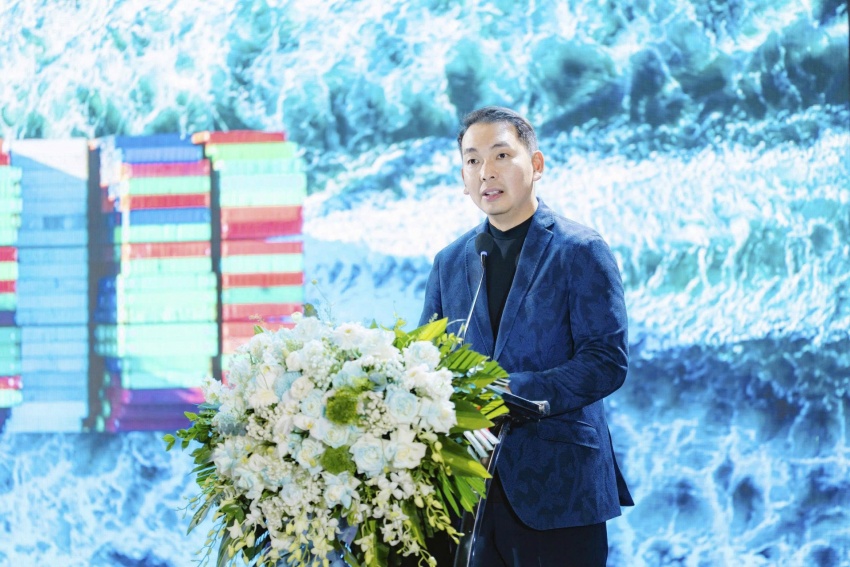
The conference was co-organised by TAPA APAC and Vietnam SuperPort, a joint venture between YCH Group and T&T Group on June 2, bringing together policymakers, international organisations, and enterprises to discuss supply chain security, multimodal logistics, digital transformation, and regional connectivity.
The event examined how integrated standards, multimodal logistics infrastructure, and digital platforms can strengthen resilient and trusted supply chains. It highlighted the role of security, connectivity, and digital enablement in supporting cross-border trade and supply chain diversification. The initiative also showcased how collaboration between Singapore and Vietnam can position Vietnam as a strategic logistics gateway in the region.
Dr. Yap Kwong Weng, CEO of Vietnam SuperPort
Dr. Yap Kwong Weng, CEO of Vietnam SuperPort, opened the conference by highlighting the structural changes reshaping global supply chains. Rising tariffs, geopolitical tensions and disruptions along key shipping routes have increased logistics costs and operational uncertainty, making resilience a strategic necessity rather than a competitive advantage.
To address these challenges, he outlined the development of Vietnam SuperPort, a multimodal logistics hub in Phu Tho Province integrating air, sea, road and rail connectivity into a single ecosystem. A major milestone is the Off-Airport Cargo Terminal (OACT), which has secured all required international security certifications and is preparing to commence operations. Future developments include an inland container depot linked to Haiphong Port, enhanced maritime connectivity through a partnership with Vietnam Maritime Corporation (VIMC), and rail integration with the future Lao Cai–Hanoi–Haiphong corridor.
Weng also explained the role of digitalisation through the Logistics Marketplace Platform, which connects logistics providers, customers and financial institutions to improve supply chain efficiency and expand access to working capital financing.
Vu Viet Van, member of the Standing Committee of Phu Tho Party Committee, Vice Chairman of Phu Tho People’s Committee
Vu Viet Van, member of the Standing Committee of Phu Tho Party Committee, Vice Chairman of Phu Tho People’s Committee highlighted the province’s strategic location as a gateway connecting Hanoi with Vietnam’s northern mountainous region.
He noted that Phu Tho has achieved strong economic growth, attracting increasing investment while continuously improving its business environment and infrastructure. According to him, Vietnam SuperPort is one of the province’s most significant strategic projects, expected to strengthen multimodal connectivity, attract investment, and accelerate industrial, commercial and service-sector development.
The vice chairman also welcomed TAPA’s participation in promoting international best practices in cargo protection, risk management and supply chain security. He reaffirmed the province’s commitment to supporting investors and businesses through transparent policies, administrative reforms and a favourable investment climate. He expressed confidence that the conference would generate valuable insights and foster new partnerships to support the growth of Vietnam’s logistics industry and Phu Tho’s.
Mai Xuan Son, general director of T&T Group
Mai Xuan Son, general director of T&T Group, said the company’s long-standing commitment to investing in sectors that serve as economic foundations, including infrastructure, energy, logistics, aviation and trade.
He highlighted Vietnam SuperPort as a flagship collaboration between T&T Group and Singapore-based YCH Group. Designed with a capacity of up to 800,000 TEUs, the project aims to become an international-standard multimodal logistics hub supporting cross-border trade and regional connectivity.
Son noted that supply chain resilience has become increasingly important amid geopolitical tensions, climate-related disruptions and rapid technological change. He stressed that logistics transformation today extends beyond physical infrastructure to include integrated digital ecosystems. Vietnam SuperPort is developing an all-in-one digital logistics platform that connects warehousing, transportation, enterprise systems, payments and financial services.
The platform will enable real-time cargo tracking, streamline documentation, improve transparency and optimise cash flow. The adoption of AI, robotics and automation is also expected to enhance productivity, safety and operational efficiency across the logistics chain.
Ian Liew, manager, Strategy and Partnerships, YCH Group
Ian Liew, manager, Strategy and Partnerships at YCH Group, shared insights into the growing importance of multimodal connectivity amid global supply chain disruptions. He identified three major challenges facing global trade today, including geopolitical tensions and maritime disruptions, port congestion, and increasing climate-related risks.
According to Liew, global trade is becoming more regionalised, with businesses increasingly prioritising resilience and diversification. He cited growing intra-Asia trade flows and rising manufacturing investment in Vietnam as evidence of the country’s expanding role within regional supply chains.
He explained that resilient supply chains are built on three pillars: multimodal connectivity, secure cargo handling and digital ecosystems. Vietnam SuperPort integrates these elements through its network of air, sea, road and rail infrastructure. Key developments include the OACT, the inland container depot, strategic cooperation with VIMC and future rail connectivity linked to the Lao Cai–Hanoi–Haiphong corridor.
Max Tran, product owner, Doxa Holdings International Pte Ltd
Mark Tran, product owner, Doxa Holdings International Pte Ltd explained that many businesses continue to face three major challenges including manual processes, limited visibility into operational data and difficulties accessing financing. Doxa Connex addresses these issues by digitising supply chain workflows, providing real-time analytics and integrating payment and trade finance services.
The platform digitalises documents ranging from purchase orders and invoices to bills of lading and customs declarations, while connecting with existing ERP and logistics systems. Businesses can manage transactions, monitor performance and improve operational efficiency through a single platform.
Dang Tuyet Dung, country director, Visa Vietnam and Laos
Dang Tuyet Dung, country director of Visa Vietnam and Laos, presented Visa’s perspective on embedded payments and finance, a growing trend that integrates payment and financial services directly into digital platforms and marketplaces.
She noted that the global business-to-business payments market is estimated at $10-15 trillion, creating significant opportunities for embedded finance solutions. Businesses are increasingly seeking automated payment processes, enhanced data visibility and easier access to financing, while digital platforms are looking for new ways to increase customer engagement and generate value-added services.
Leveraging its global network spanning more than 220 countries and territories, Visa provides secure payment infrastructure, real-time reconciliation capabilities and flexible integration options for enterprise platforms.
Within the Vietnam SuperPort ecosystem, Visa is working with Doxa and Techcombank to connect trade, logistics, payments and financing. The integrated solution helps businesses improve transparency, accelerate access to capital and optimise working capital management.
Julian Tan, secretary and board member of TAPA Asia-Pacific
Julian Tan, secretary and board member of TAPA Asia-Pacific addressed the evolution of global supply chains and the growing need for integrated risk management.
He argued that disruptions driven by geopolitical tensions, cyber threats, climate events and trade conflicts are no longer temporary challenges but permanent realities. As a result, businesses must shift their focus from compliance-based approaches to resilience-driven strategies.
TAPA advocates an integrated security framework that combines standards covering warehouses, transportation, air cargo, cybersecurity, risk assessment and business continuity management. Through its Integrated Audit Framework, organisations can assess operational resilience, cyber readiness and transport security within a single structure.
At the event, Vietnam SuperPort was awarded the TAPA FSR Level A Certification, the highest level under the facility security standards established by TAPA, reaffirming Vietnam SuperPort®’s operational capabilities in safety, transparency, and compliance with international standards, while contributing to the continued enhancement of Vietnam’s logistics competitiveness within global supply chains.
TAPA FSR serves as a global benchmark for secure supply chain operations. Achieving Level A certification demonstrates that Vietnam SuperPort® meets the highest standards for warehouse security, access control, perimeter protection, and governance, further strengthening its position as a trusted and modern multimodal logistics hub supporting Vietnam’s integration into global supply chains.
During a panel discussion, speakers from Vietnam SuperPort, Doxa Holdings International, and TAPA Asia-Pacific moderated by Tien Nguyen, assistant to CEO and deputy director of Strategy and Plans at Vietnam SuperPort, shared practical insights on how businesses can strengthen resilience and trust across increasingly complex global supply chains.
Weng highlighted adaptability as one of the most critical capabilities for businesses operating in an increasingly uncertain world. He encouraged organisations to embrace change, strengthen partnerships, and develop a stronger sense of purpose in navigating future challenges.
According to him, resilient supply chains cannot be built by individual companies alone; they require collaboration across governments, logistics providers, technology partners, manufacturers, and financial institutions. He also emphasised that as supply chains become more interconnected, organisations must move beyond traditional operational models and foster greater cooperation and trust throughout the ecosystem. Building resilient supply chains, he argued, will depend not only on infrastructure and technology but also on the willingness of stakeholders to work together towards shared long-term goals.
Tony Lugg, chairperson of TAPA Asia-Pacific
Tony Lugg, chairperson of TAPA Asia-Pacific, stressed that disruption has become a permanent feature of the global business environment. From geopolitical conflicts and natural disasters to cyber threats and operational disruptions, companies must be prepared to respond quickly and effectively. He explained that resilience is built through business continuity planning, regular crisis simulations, and learning from previous disruptions.
Drawing on his experience in the logistics industry, Lugg shared how organisations that anticipate risks and establish alternative transport options can turn challenges into opportunities. He also highlighted that supply chain security and brand protection are becoming increasingly important differentiators, particularly as multinational companies place greater emphasis on trusted logistics partners and secure operations.
Edmund Ng, founder and CEO at Doxa Holdings International
Edmund Ng, founder and CEO at Doxa Holdings International, focused on the role of digitalisation in creating more efficient and resilient supply chains. He noted that many businesses continue to struggle with fragmented and duplicated data across procurement, logistics, transportation, and financial systems. According to Ng, improving connectivity between stakeholders is essential to reducing inefficiencies and increasing visibility across the supply chain.
He explained how integrated digital platforms can enable real-time information sharing, automate manual processes, and support better decision-making. By connecting logistics, trade documentation, payments, and financing within a single ecosystem, businesses can improve productivity, enhance transparency, and respond more effectively to disruptions.
Conference concludes with a call for stronger partnerships and operational resilience.
In his closing remarks, Lugg emphasised that supply chain disruption is no longer an occasional challenge but a permanent feature of the global operating environment. As geopolitical tensions, climate events, and economic uncertainties continue to reshape trade flows, businesses must move beyond traditional approaches to risk management and focus on building true operational resilience.
He highlighted that resilience is not defined by certifications alone or by business continuity plans that remain on paper. Instead, it must be embedded into daily operations, decision-making processes, and organisational culture. He encouraged companies to integrate security standards directly into their operational frameworks so that they can continue functioning effectively across air, land, rail, and sea transport networks when disruptions occur.
Lugg also underscored the importance of collaboration between governments, industry players, and international organisations in building trusted supply chain ecosystems. Citing Vietnam SuperPort as an example of meaningful regional cooperation, he noted that no single organisation can build resilient supply chains alone. Long-term success will depend on strong partnerships, shared standards, and collective efforts to strengthen security, trust, and connectivity across the region.
He expressed optimism about Vietnam’s growing role in regional trade and logistics, while encouraging businesses to embrace adaptability, operational readiness, and collaboration as key foundations for future growth.
