
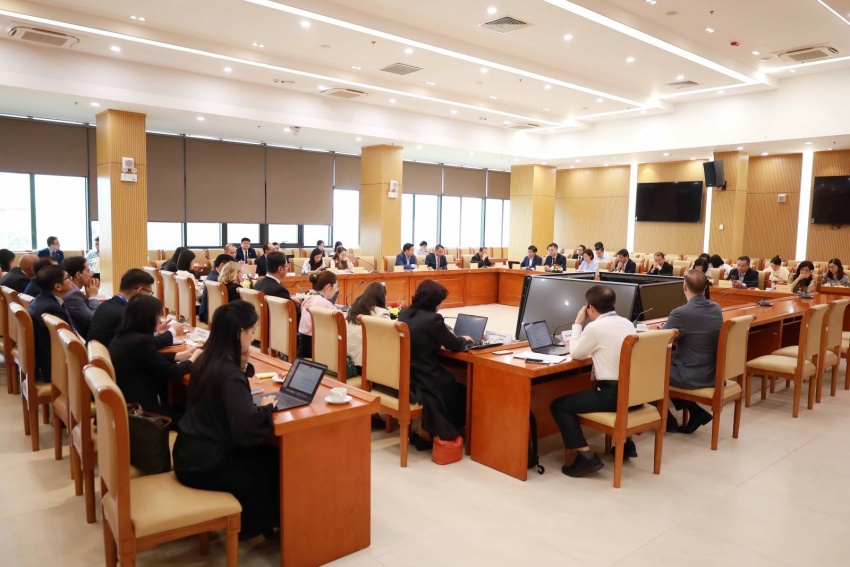
A US-ASEAN Business Council (USABC) delegation led by Penny Burtt, president of Boeing Southeast Asia, held talks with representatives of the Ministry of Construction (MoC) on April 16. The mission included leading investors such as FedEx, Atlas Air Worldwide, and UPS.
Photo: The MoC
She stated that the US business community is eager for the MoC to share information and discuss ways to support Vietnam in its new development phase, with a focus on boosting innovation-based growth. Areas of their interest include the ministry’s priorities in effectively implementing key national infrastructure projects, developing social housing, and building a transparent and stable legal framework for housing, urban development, and the real estate market.
Accordingly, cooperation directions could focus on developing modern, highly interconnected, and resilient infrastructure systems; utilising sustainable urban development; and improving construction efficiency.
The others are supporting the modernisation of the logistics sector and related infrastructure, aiming to enhance Vietnam’s ability to participate in diverse and resilient global supply chains; while encouraging the application of technology and innovation in the fields of construction, engineering, and urban planning.
Specifically, transportation companies such as FedEx, Atlas Air Worldwide, and UPS plan to increase investment and expand their presence in Vietnam, aiming to develop freight and logistics operations, especially air freight.
Businesses also requested that the MoC and relevant agencies of Vietnam create stronger conditions for investment and expansion of transportation service infrastructure at airports, as well as improve policies to support the development of transportation, logistics, and transport.
Photo: The MoC
In the aviation sector, Boeing expressed its readiness to partner with and support Vietnam in commercial aviation, defence and security, supply chain development, technical training, and community initiatives. This includes aspects of fleet development, ensuring aviation energy security, and encouraging the use of sustainable aviation fuels.
In response, Deputy Minister of Construction Nguyen Tuong Van expressed appreciation for the interest and positive contributions of USABC member businesses to Vietnam’s economic development in recent years.
He stated that as Vietnam accelerates the development of synchronous and modern infrastructure, the need to mobilise resources, absorb international experience, and apply science and technology is immense.
“Therefore, the ministry wishes to strengthen cooperation with US businesses in the development of transportation infrastructure such as airports, seaports, and railways, as well as in other areas including urban development, building materials, digital transformation, and high-quality workforce training,” he said.
Regarding transportation infrastructure development, the Socioeconomic Development Strategy for the period 2021-2030 prioritises the development of expressways, airports, high-speed rail and urban rail systems, and seaports, while strengthening transportation connectivity between regions, such as the Mekong Delta and the northern mountainous region; along with focusing on solutions to address climate change and flooding.
Photo: The MoC
Deputy Minister Van noted that Vietnam has achieved significant progress in the transport and construction sector. The North-South expressway has been largely completed, bringing the total length of expressways nationwide to more than 3,000 km. Investment in Long Thanh International Airport is being accelerated, research is under way on the North-South high-speed railway, and the seaport system currently operates 306 berths.
Vietnam has also issued key policies to promote investment in transportation infrastructure, focusing on mobilising diverse sources of capital, including the non-state sector and international organisations, while refining the legal framework, investment incentives, and specific mechanisms.
The state encourages foreign investment and public-private partnership models in the infrastructure sector, applying preferential tax, fee, and land policies for businesses investing in transportation and urban development, while also promoting industrial development and technology transfer.
Regarding the proposals from US businesses, the deputy minister acknowledged them and said he would assign relevant units to compile, research, and consider them during policy finalisation and implementation. He also said the ministry is ready to act as a focal point for information exchange and business support within its assigned functions.
Deputy Minister Van expressed hope that US businesses would continue sharing international experience and proposing specific, feasible solutions to improve planning, design, construction, and operation of infrastructure projects in Vietnam, while focusing on cooperation in training and human resource development to enhance the construction industry’s capacity.
“We hope to receive close cooperation from businesses, especially in essential infrastructure sectors, which are currently key areas for investment attraction in Vietnam,” he said.
He requested that businesses continue contributing policy opinions and proposing cooperation and investment initiatives with the ministry to achieve practical and effective results.
US-ASEAN links attain higher status
Given the current global challenges and uncertainties, the US-ASEAN business community is pinning high hopes on new opportunities in Vietnam backed by strong support from the government.
Cooperation advantages from US-ASEAN relations
The economic landscape of Vietnam has undergone remarkable transformations, positioning it as one of the most dynamic and rapidly growing economies in Southeast Asia. The country has increasingly become a key player in the global market, attracting foreign direct investment from around the world, with the United States standing out as one of the most significant contributors.
Taking proactive steps to keep strong US interest in Vietnam
As US-ASEAN companies maintain a strong interest in Vietnam, a new surge of investment is expected despite tariff uncertainties. Ted Osius, president and CEO of the US-ASEAN Business Council, spoke to VIR’s Thuy Nguyen about how to hold the attention of the US.
US business delegation heads to Vietnam to foster cooperation
A high-level US business delegation will pay a visit to Vietnam to promote trade investment and long-term partnerships.
Vietnam, US business council discuss energy, high-tech cooperation
Vietnam and the US are advancing economic cooperation across key sectors including energy, high technology, logistics, trade, healthcare, and consumer goods.
