
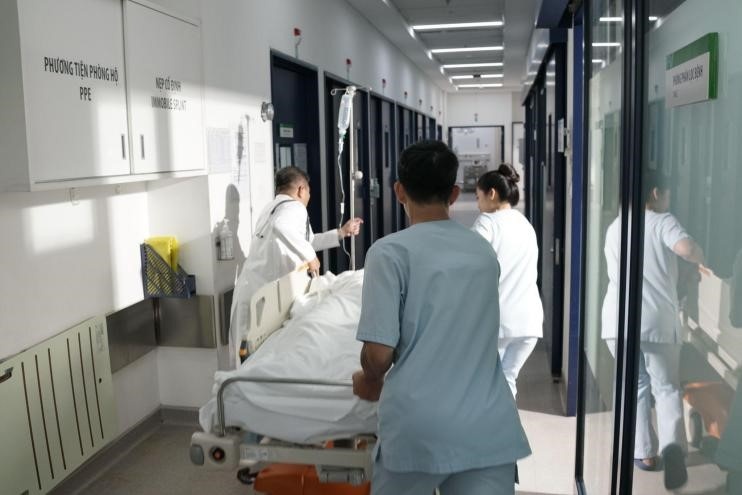
On March 11, the hospital reported that a 31-year-old Israeli national was admitted to the emergency room in the middle of the night with severe chest and epigastric pain. Imaging results revealed a large mediastinal tumour located close to the heart, suspected to originate from the lower third of the oesophagus, with signs of internal bleeding.
Pham Luu Nhat Hoang, specialist Level II – deputy head of Accident and Emergency Department, FV Hospital said that just two hours after admission, FV had received the test results and invited a specialist in thoracic surgery for a consultation.
“The speed of interdisciplinary collaboration helps shorten diagnosis time and supports treatment decision-making,” said Hoang.
Photo: FV
The patient was diagnosed with a submucosal esophageal tumour, but was showing signs of bleeding within the mass.
An endoscopic esophageal biopsy carried a high risk of bleeding complications. This presented a difficult problem: without a biopsy, it was impossible to determine whether the tumour was benign or malignant, yet surgery could not be delayed due to the risk of re-bleeding.
During interdisciplinary consultation, the FV team developed several scenarios for managing the tumour. If the tumour proved benign and dissection was safe, the oesophagus would remain unaffected.
If it was cancerous or the oesophageal wall could not be adequately closed, doctors would be forced to remove a section of the oesophagus and reconstruct it using a gastric tube.
Dr Dang Dinh Minh Thanh, head of the Thoracic Surgery and Robotic Surgery Centre at FV Hospital, assessed the case as complex. The tumour measured approximately 6x10x10 cm and was located close to the heart – an anatomically difficult site to access. Given the limited operating space, complex structures, and high bleeding risk, robot-assisted surgery was deemed the optimal approach.
The surgery was performed by Dr Thanh using the da Vinci Xi robotic system, the latest generation available in Southeast Asia. Compared to conventional endoscopy, the system provides magnified, vibration-dampened 3D HD images, allowing precise manipulation in the tight space behind the heart.
During the surgery, the team performed a frozen-section analysis to rule out carcinoma. Upon dissection, the tumour was identified as a cyst with a shell nearly 1cm thick containing old blood fluid – evidence of previous bleeding, which had caused the severe pain.
After the tumour was completely removed, the remaining oesophageal wall was safe enough to be sutured closed. The surgery was successful, and the oesophagus was preserved for the young patient.
Dr. Thanh with the patient post-surgery. Photo: FV
Just two hours after surgery, the patient was alert and in good spirits. Tests for oesophageal fistula returned negative, and subsequent analysis confirmed the tumour was benign.
The family had considered returning to Israel for treatment. However, after Dr Thanh explained the unpredictable risk of re-bleeding – particularly dangerous if it occurred during a flight – they decided to proceed with surgery at FV Hospital.
The patient said he chose FV because he lives near the hospital and has relatives who have been successfully treated there. “I believe I’ve come to the right place,” he said.
Robotic surgery: a new frontier in complex thoracic treatment
According to Dr. Thanh, the success of this surgery demonstrated the increasingly important role of robotic surgery in treating complex thoracic diseases, especially large, difficult-to-locate esophageal tumours.
“Robotic surgery increases accuracy, reduces invasiveness, minimises conversion to open surgery, and shortens recovery time. These are obvious advantages, especially for high-risk cases,” he noted.
Surgery performed using the da Vinci Xi robot at FV Hospital. Photo: FV
FV Hospital has been using the da Vinci Xi robotic surgical system since early 2026. Following positive outcomes in thoracic and general surgery, the hospital is expanding its application to other specialities:
Urology: treatment of prostate and bladder cancer
Digestive: surgery for stomach and colorectal cancer, particularly for tumours in hard-to-reach areas
Gynaecology: treatment of uterine and ovarian cancer, and fibroid removal with uterine preservation
Ear, Nose, and Throat: surgery for head, face, and neck tumours
To improve access to robotic surgery, FV Hospital is offering support for 50 cases at VND40 million ($1,600) per procedure until June 15. For inquiries, visit FV Hospital at 06 Nguyen Luong Bang Street, Tan My Ward, Ho Chi Minh City, or call (028) 3511 3333.
Race against time: FV doctors save elderly patient from stroke and acute myocardial infarction
An 80-year-old man suffering from both a stroke and an acute myocardial infarction was saved within minutes thanks to FV Hospital’s 24/7 “Golden Hour” cardiac response team and international-standard Cathlab.
FV Hospital’s integrated care model proves comprehensive and effective
The intensive care unit (ICU) is often seen as the frontline in the battle for patients’ lives, where the collaboration between multiple specialities determines success. At FV Hospital, a multidisciplinary, comprehensive care model has demonstrated remarkable effectiveness in treating critically ill patients.
FV Hospital CFO honoured by UK magazine
Women’s Tabloid magazine (UK) has honoured Tran Le Quyen, CFO of FV Hospital in the category of Best Emerging Woman CFO in Healthcare 2025. Here she speaks with VIR’s Thanh Van about her journey.
