
Introduction
“Cole, how do you know what cue to give an athlete so they will remember it for next time and I don’t have to keep giving the same one over and over?”
A lot of my interns through the years have had this question because they want to learn how to get better at teaching proper technique. I wanted to share my secret recipe for giving memorable cues (because I think I am half-decent at it).
Tell a story.
I wanted to share my secret recipe for giving memorable cues – tell a story, says @chergott94
Share on X
The Art of Coaching: Be a Story Teller
You see, stories evoke emotions, they help people relate what they are about to do to another thing they have done before, and it makes coaching WAY more fun.
Let me give you an example…
Say the person you are coaching is having a hard time with their feet when squatting as their ankles keep collapsing inward when they get to the bottom.
You could tell them to twist their feet into the floor when they squat to create a better tripod foot and not allow their foot arch to collapse thus leading to their ankles rolling in (which would be an internal cue).
Or you could tell them to think of their feet like a screw and they need to screw their feet into the floor while they squat (which is an external cue).
The more tangible the word-picture you paint for them is, the more they’re going to “feel.” For instance, you could ask a young male if he’d met his girlfriend’s dad yet. Hopefully they say yes. Now, ask them how they shook her father’s hand the first time they met. They will undoubtedly say “very firm/hard.” You then tell them to treat the floor and their feet the same way. Grab hold, twist firmly, and don’t be the first to let go. While this is still just an external cue, the story adds some pizzazz to it and will drive home a point they will never forget.

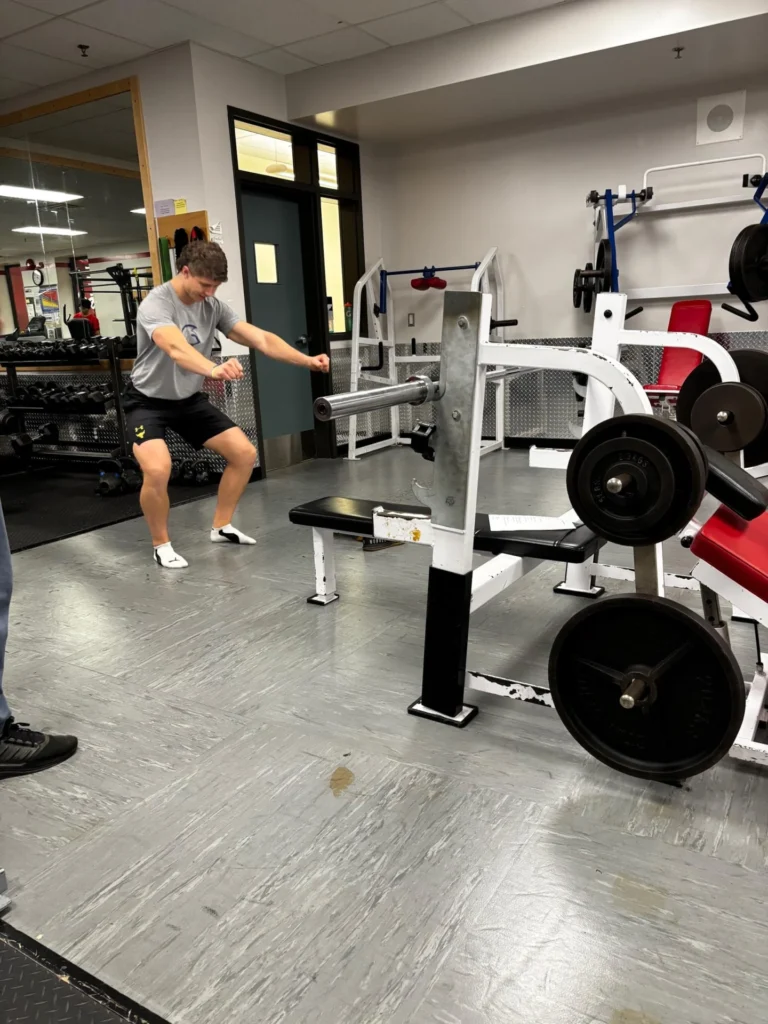
Image: You can tell by the supinated feet screwing into the ground that this athlete knows how to shake a man’s hand – or that he limp-noodled it last time and never wants to feel that again.
A Good Story Makes You Feel Like You’re There
A quote I really like as a coach is “They might forget what you said, or what you did, but they will never forget how you made them feel”. Now while this is a great one to help young coaches learn emotional intelligence and just be a genuinely nice person, I want to flip it a bit and use it to my advantage in coaching. People remember feelings. Good stories don’t just tell you what happened, they make you feel like you’re right there with them – like the one where you met your significant other’s dad. I still remember meeting my father in-law for the first time. I don’t remember what he wore. I don’t remember what he said, but I sure as heck remember the feeling of having to shake his hand the first time. (And no, my ankles don’t collapse when I squat!).
Let’s see another example…
Let’s say your athletes are struggling to get to full depth in a split squat and you want them to get their knee to the floor without smashing it on the ground.
You could tell them to drop lower/flex deeper in the hip/bend their knee more so they get to full depth (internal cue), or you could tell them to lightly kiss their knee on the floor with each rep (external cue).
Or you could tell them that if they ever came to your house to visit, they would need to ring the doorbell when they get there. But if they just stood outside and constantly stopped 2 inches short of actually hitting the doorbell every time they tried to ring it, I would never know they were there and they would just be standing outside looking silly. But then you need to tell them if they decided to smash the doorbell really hard that they would not only damage the doorbell but also potentially break their finger. The only way to ensure safety for all while still alerting me of their presence is to lightly hit the doorbell. Then you tell them that the floor is the doorbell and their knee is their finger- “ring the doorbell, but don’t break it” (story for the win).

Image: Use feelings and stories to cue, not just body part sequences. Instead of telling kids “hips back” to teach the hinge, tell them “imagine you’re carrying in the groceries and your hands are full. Use your hips to bump back and shut the car door.”
Again, everyone can relate to not wanting to be seen as “silly,” so they usually do it right to avoid any of their peers making jokes. Plus all I have to do in subsequent sessions is say “ring the doorbell!” and it invokes the story and everyone gets down to the floor.
So tell stories. Find things that are similar to what you are coaching. And if there really isn’t anything, make it up. Steal stories from other coaches. I have a story to teach a hinge by closing the car door while carrying grandma’s groceries. I have a story to teach squatting while hanging out in a pool. I have a story to teach Olympic lifts by pretending you are being pulled behind a boat. Some of these I came up with, some I adapted for the times. You’ve gotta make sure you’re communicating a feeling that the modern generation can relate to. I used to say “do Hang Power Cleans in a phonebooth” to limit forward bar path. Now I have to say “clean in a small hallway and don’t hit the walls” because ain’t nobody that I coach knows what a phonebooth is anymore! The goal isn’t to say what’s familiar to you, it’s to communicate a feeling to help them build the right movement patterns.

Image: Not everyone has a vivid imagination. Be sure to help translate the story you’re cueing with from book to movie by showing how to perform the movement while you’re giving the demo.
Bringing This Story to a Close
I could go on and on about this stuff, but there really is no secret. Just be creative. When you see or do something yourself and you think, “hey, this is kind of like that other thing,” write it down for your next coaching adventure.
So for ease of use and to get your creative juices flowing, here is a little cheat sheet of common movement flaws and ways to turn your cues into a story:
Issue: Excessive Backside Mechanics
Don’t: “Knees up!”
Do: “Hide the soles of your feet from Jesus”
Issue: Lopsided/Sagging Hips During a Plank
Don’t: “Brace your core!”
Do: “Pretend there is a bucket of water on your hips. Don’t let it spill”
Issue: Elbows Dipping in Front Rack Position
Don’t: “Keep elbows up!”
Do: “Pretend there is a bad guy in front of you and your elbows have lasers coming from them. Don’t hit them in the foot, hit them in the chest!”

Image: Anyone that’s worked with large groups of high schoolers or middle schoolers knows that commanding the floor and maintaining attention is crucial. Using story telling in your demos helps keep them interested and decreases the chance of them having side conversations.
Issue: Ribs Flaring Up in an Overhead Press
Don’t: “Stay tell/brace your abs!”
Do: “Be a stone pillar. Don’t move!”
Issue: Slow Turns from Thuffle to Sprint
Don’t: “Turn fast!”
Do: “Pretend I am holding the side of your shorts. Lose me!”
Being a good storyteller transforms you from a youtube tutorial into a much more effective coach that connects people’s actions to feelings they won’t forget. Plus, it is way more fun to tell the story than to give an internal cue that’ll leave them looking like a deer in the headlights. Yuck!
Being a good storyteller transforms you from a youtube tutorial into a much more effective coach that connects people’s actions to feelings they won’t forget, says @chergott94
Share on X
Good luck, coaches!
Peace. Gains.
Cole Hergott
The post Making Cues Memorable appeared first on SimpliFaster.
