
As investment decisions prioritise supply chain resilience, policy stability, and environmental, social, and governance (ESG) standards, the market is forecast to enter a more selective phase, with clearer differentiation based on model quality and operational capabilities.
According to CBRE Vietnam, Vietnam’s industrial land leasing activity remained subdued in 2025. In the southern region, net absorption decreased by 39 per cent on-year despite resurging demand driven by new supply in the second half of the year. Meanwhile, future supply remains significant, with over 1,000 hectares of new industrial land to be added in the southern region this year.
This development reflects a market adjustment, as land leasing decisions become more cautious and selective. In the previous period, developers’ competitive advantages lay in scale and expansion speed. In the new cycle, developers are shifting their focus towards infrastructure standardisation, service integration, and long-term operational capacity aligned with international standards.
ESG becomes the new operating standard
Along with the shift in investment criteria, ESG is gradually becoming the operating benchmark for industrial parks. For industrial park developers, ESG is no longer merely a competitive advantage, but a necessary condition for maintaining a position within global supply chains.
Investors are paying more attention to green infrastructure, stable energy systems, water resource management, wastewater treatment, and the ability to implement industrial symbiosis models. This signals a structural transformation: industrial real estate must not only provide manufacturing space but also ensure sustainable, transparent, and resilient operational capacity over the long term.
Since 2025, ESG considerations have increasingly shaped industrial real estate development and are expected to remain a key driver in 2026.
However, this transition also presents significant challenges. Amid geopolitical uncertainties and the global supply chain restructuring trend, foreign investors have become more cautious in making long-term commitments. They also impose higher requirements for policy stability, supply chain safety, and adaptability to disruption scenarios.
Furthermore, the rollout of next-generation industrial park models, particularly eco-industrial parks, continues to encounter challenges related to the policy framework and consistency in the application of criteria, as several regulations and implementation guidelines remain under finalisation. Against this backdrop, foreign direct investment (FDI) flows are projected to become increasingly selective, prioritising projects with clear orientations towards sustainable operation and strong adaptability.
Strategic preparations for 2026
Amid ongoing shifts in FDI patterns and ESG standards, the market is expected to witness a clearer differentiation based on model quality and execution capability in 2026. Rather than expanding supply at any cost, many developers are shifting their focus towards standardising the industrial park model, deepening infrastructure investment, and building long-term operational foundations to meet the increasingly stringent requirements of international investors.
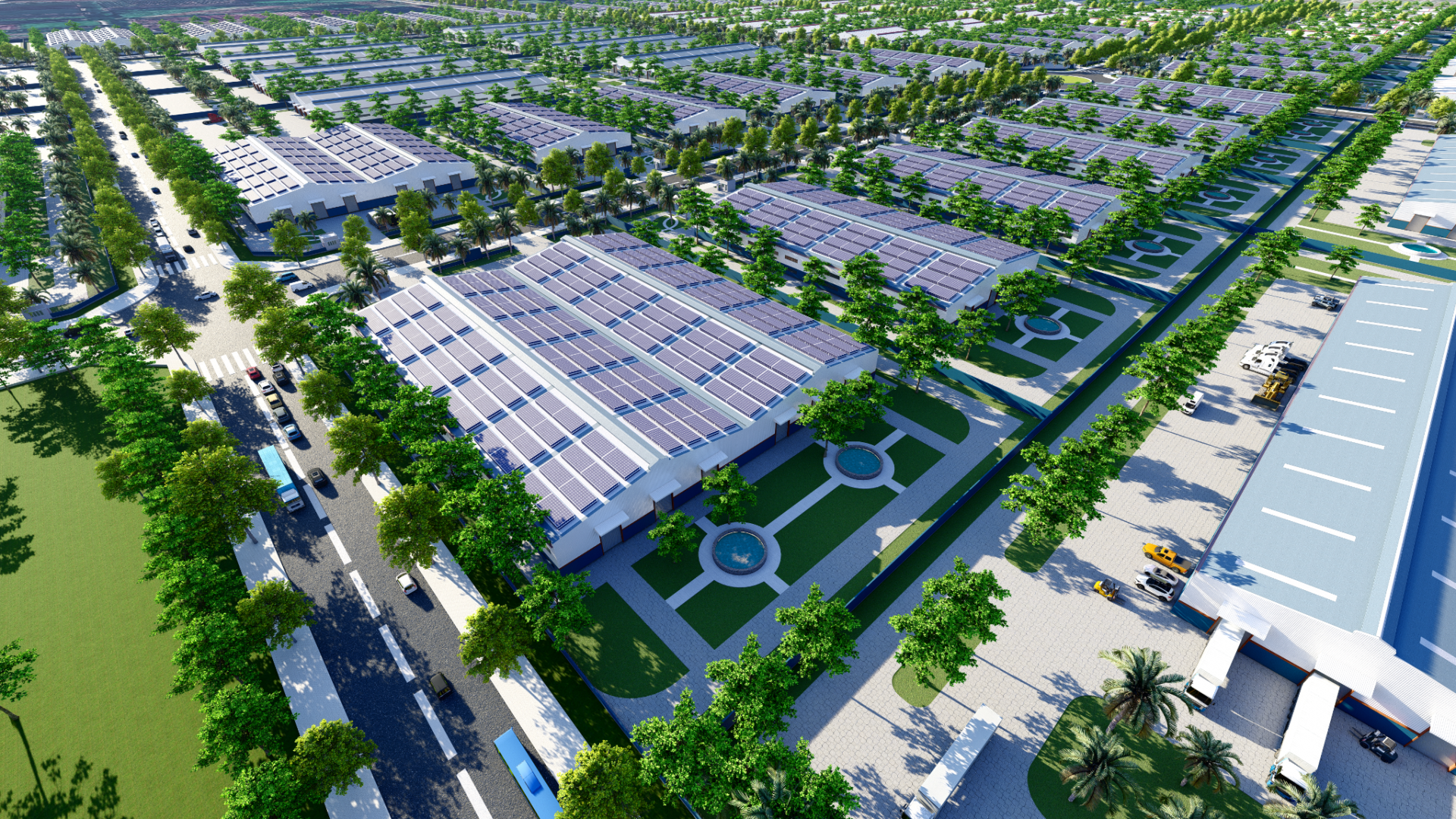
For example, Prodezi Industrial Park has adopted the eco-industrial park model from the planning stage, integrating sustainability principles into its overall development strategy. In this new cycle, the industrial park is designed not only to provide manufacturing space but also to function as an integrated platform where technical infrastructure, support services, and operational systems are structured to meet long-term manufacturing needs.
The industrial symbiosis model at Prodezi Industrial Park helps increase resource efficiency and reduce operating costs for tenants.
In terms of infrastructure, Prodezi Industrial Park prioritises stability and contingency capacity. Its energy system is planned as a multi-source structure, combining grid electricity and renewable energy. Comprehensive investment in water supply, wastewater treatment, and environmental management systems has been made from the beginning to meet the increasingly stringent standards of global supply chains, particularly for foreign-invested enterprises with ESG requirements.
A highlight of the company’s approach is its industrial symbiosis strategy, whereby energy, water, and material resource flows are designed to be shared and optimised across the entire park. According to internal estimates, this model may improve resource efficiency and potentially reduce tenants’ operating costs by approximately 8–12 per cent, while simultaneously lowering production-related emissions.
Truong Khac Nguyen Minh, deputy general director of Prodezi Long An said, “In 2026, we will continue integrating ESG principles across infrastructure, operations, and governance in a structured and measurable manner. We believe that comprehensive preparation will enable our tenants to better meet the increasingly stringent requirements of the global supply chain while contributing meaningfully to Vietnam’s broader sustainable development agenda.”
Prodezi Long An advances towards integrated eco-centric industrial park model
Prodezi Long An JSC is focusing on industrial symbiosis to optimise the use of resources and energy while reducing emissions. VIR’s Binh An spoke with Truong Khac Nguyen Minh, deputy general director of Prodezi Long An, about the service-connection model the company is pursuing.
Green industrial parks offer solution to ESG challenges for next-generation businesses
As environmental standards increasingly become a prerequisite for participation in global supply chains, the shift towards sustainable production models has become a matter of survival.
Vietnam’s growth formula evolves as high-tech and green industries take lead
Vietnam is entering a new phase of economic transformation where foreign direct investment (FDI), high-tech industries, environmental, social, and governance (ESG) commitments, and human resources quality will define its growth path. Industry leaders highlight that the next generation of industrial parks must evolve to be green, smart, and integrated to meet investors’ rising standards and Vietnam’s net zero ambitions.
