
In an official dispatch released on April 3 on measures to support air transport enterprises amid fluctuations in Jet A-1 fuel prices, the Ministry of Construction (MoC) issued a response to a proposal from the Civil Aviation Authority of Vietnam (CAAV) regarding application of a fuel surcharge for domestic passenger air transport, to be applied outside the current price cap for basic economy-class domestic airfares.
“We are urgently working to clarify issues as directed by the MoC regarding the application of a domestic aviation fuel surcharge mechanism, to promptly remove difficulties for airlines,” said CAAV director-general Uong Viet Dung last week.
The MoC has requested the CAAV to further study, supplement, and clarify the legal basis, decision-making authority, and methodology for determining the fuel surcharge. At the same time, it has called for an assessment of the appropriateness of the current price ceiling for basic economy-class domestic air transport services, as well as an assessment of airlines’ production and business performance following the implementation of support policies by the government and relevant management agencies.
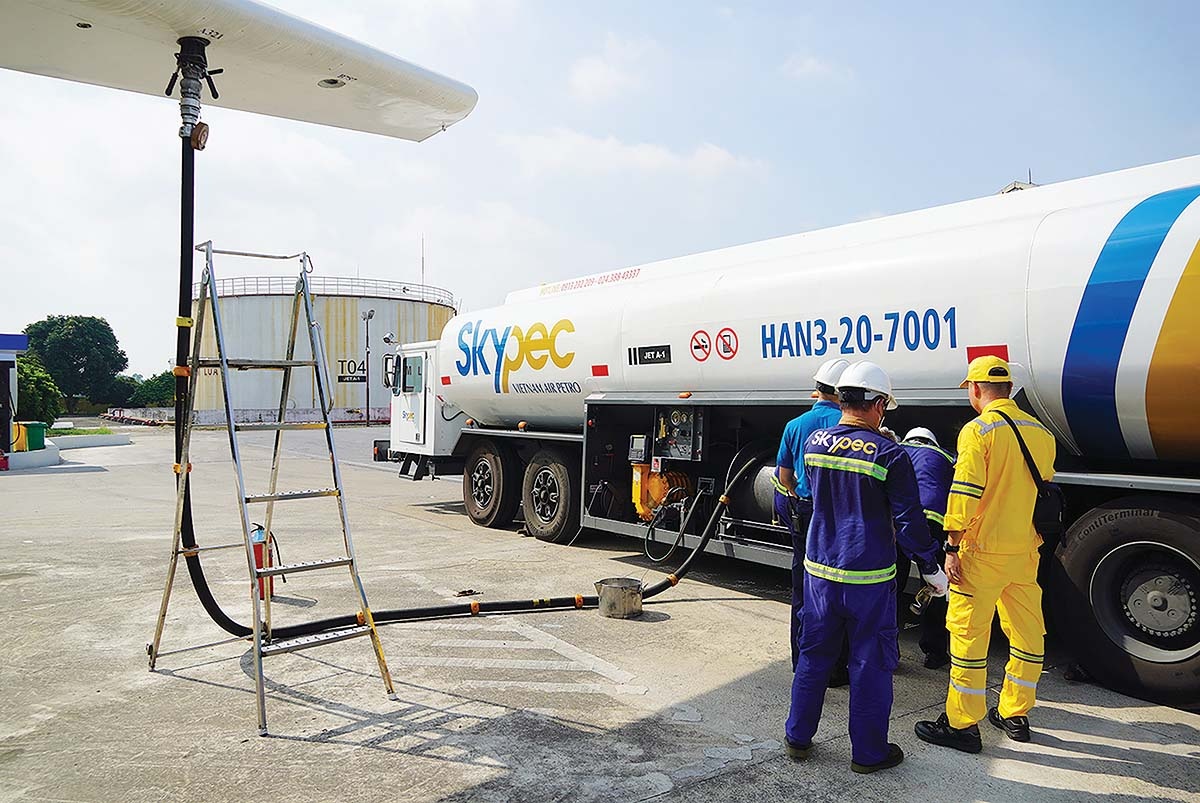
Aircraft refuelling at Noi Bai International Airport
At present, the process of formulating, appraising and issuing decisions to adjust the price ceiling is time-consuming, failing to keep pace with rapid fuel market fluctuations and making it difficult to ensure fairness and transparency for consumers.
“Therefore, it is necessary to implement an emergency policy allowing the temporary application for about three months of a fuel surcharge mechanism for domestic economy-class air passenger transport services, to promptly respond to abnormal fluctuations, ensure stable aviation operations, align with international practices, and balance the interests of the state, businesses and society while considering people’s ability to pay,” Dung said.
On March 25, CAAV had proposed that the MoC report on urgent solutions to support aviation operations in response to adverse Jet A-1 fuel price developments.
Alongside proposals to reduce takeoff, landing and air traffic control service fees, the CAAV recommended extending the zero import tax, cutting the environmental protection tax to VND1,000 per litre (about 4 US cents), and considering a reduction in VAT on Jet A-1 fuel to ease cost pressures and cash flow constraints for airlines.
Based on proposals from domestic carriers, the aviation regulator suggested that the MoC allow the application of a fuel surcharge mechanism for domestic economy-class passenger transport services (set outside the current price ceiling), with flexible adjustments in line with Jet A-1 price fluctuations.
According to the CAAV’s assessment, military conflict in the Middle East has directly impacted the global energy market, with Jet A-1 prices rising rapidly and fluctuating sharply over short periods, significantly affecting operating costs for Vietnamese airlines.
Meanwhile, the current pricing mechanism for domestic air passenger transport services still imposes a maximum fare under the Law on Prices. Without an appropriate compensation mechanism, airlines may be forced to continue cutting routes, weakening connectivity, increasing the risk of losing international slots, and undermining post-crisis recovery.
The government has taken timely supportive measures by reducing taxes on petrol, oil and aviation fuel to the lowest possible levels when necessary. At the same time, energy diplomacy efforts have been intensified to ensure a stable supply of Jet A-1 fuel for the domestic market.
On April 12, the National Assembly (NA) adopted a resolution introducing a number of provisions on environmental protection tax, VAT, and special consumption tax (SCT) applicable to petrol, oil products, and aviation fuel.
Under the resolution, the environmental protection tax on petrol (excluding ethanol), diesel, kerosene, mazut, and aviation fuel is set at VND0 per litre. The SCT rate on all types of petrol is also zero per cent. The resolution takes effect from April 16 through the end of June 30.
In addition, to ensure that the domestic petrol, oil, and aviation fuel market is managed in line with global price developments, the NA has authorised the government to issue a resolution to adjust – either shorten or extend – the effective period of this measure.
In urgent cases, the government may also adjust provisions on environmental protection tax, VAT, and SCT as stipulated in this resolution, and will report such actions to the NA at its nearest session.
These efforts are expected to ease cost pressures and create a buffer for businesses to maintain operations.
According to the CAAV, additional costs arising from fuel price fluctuations would be shared equally between airlines and passengers at a 50/50 ratio. While this still represents a significant financial burden for carriers, the approach is considered a relatively balanced way to align the interests of all parties under current conditions.
The aviation regulator also noted that the simultaneous rise in crude oil prices, refining costs and war risk insurance premiums, coupled with localised supply shortages as regional refineries cut capacity, has pushed aviation fuel costs to a new level that is likely to persist in the medium term.
In this context, airlines’ operating costs could increase by as much as 40 per cent compared with the pre-conflict period, leaving carriers on the defensive as input costs surge and fluctuate rapidly and unpredictably.
Vietnam Airlines to suspend domestic routes as fuel costs rise
Vietnam Airlines is planning to suspend several domestic routes from April 1 amid tightening Jet A-1 fuel supply and surging prices linked to Middle East tensions.
Aviation and maritime fee exemptions proposed until end-2026
The Ministry of Finance (MoF) has proposed exempting a range of fees and charges in the aviation and maritime sectors from April 1 until the end of 2026, in a move aimed at supporting businesses amid volatile fuel prices.
Rising fuel costs disrupt flight plans, squeeze airline earnings
Airlines are scaling back routes to offset surging fuel costs, as rising expenses begin to erode profitability despite solid passenger growth, reflected in mixed Q1/2026 financial results across the sector.
