
Shareholders also approved amendments to the bank’s foreign ownership provisions.
Under its new corporate governance framework, Eximbank aims to establish an independent and professional banking governance model that complies with Vietnamese law and incorporates leading international governance practices.
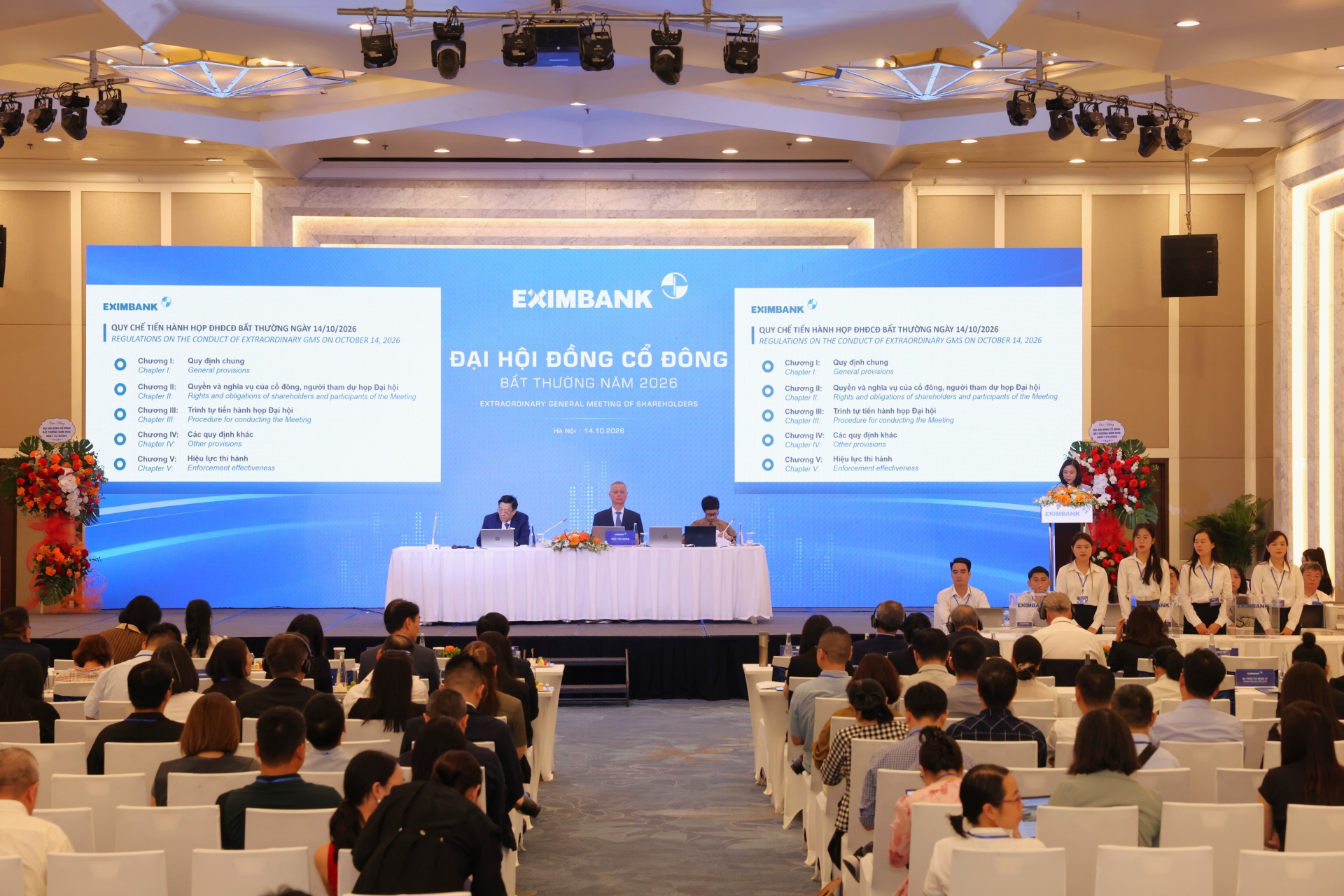
An overview of Eximbank’s Extraordinary General Meeting of Shareholders in 2026. Photo: Eximbank
Further strengthening the Board of Directors
Building on the Extraordinary General Meeting held on July 24, shareholders approved the election of one additional director for the board’s eighth term (2025–2030), increasing its membership from six to seven directors.
Among those elected was Pham Thi Huyen Trang, CEO of Eximbank. Her proposed appointment to the board had been approved by the State Bank of Vietnam in July 2026, in line with Eximbank’s previously announced governance roadmap.
The additional director were elected in accordance with the criteria set out in the bank’s corporate governance framework, with an emphasis on diverse experience, expertise, and perspectives across key areas including strategy, banking and finance, risk management, audit, technology, and human resources.
The members of the Board of Directors and the head of the Supervisory Board of Eximbank presented flowers to congratulate Pham Thi Huyen Trang, CEO, on her election as a member of the Board of Directors for the eighth term (2025–2030). Photo: Eximbank
Aligning foreign ownership limits with capital markets
Shareholders also approved amendments to the provisions governing foreign share ownership at Eximbank and the corresponding provisions of the bank’s charter.
Accordingly, Eximbank has removed the previous 6 per cent cap on aggregate foreign ownership of its charter capital stipulated in the bank’s charter and will instead apply the maximum limit permitted under applicable law.
Applying the foreign ownership limit prescribed by law also provides Eximbank with greater opportunities to engage international investors, particularly those with financial strength, corporate governance experience, and a long-term investment outlook, consistent with the Bank’s development direction.
Commitment to strong corporate governance
Nguyen Le Quoc Anh, chairman of Eximbank’s Board of Directors, said, “Strengthening Eximbank’s corporate governance model is essential to developing the bank to meet international standards.”
“The year 2026 lays the foundation for the bank’s transformation and development. Strengthening the board is not simply a matter of increasing the number of directors, but of building a leadership team with extensive experience and expertise across the financial sector, full independence, and, above all, a strong sense of responsibility towards depositors, customers, employees, and, ultimately, shareholders,” he said.
“As Vietnam becomes increasingly integrated into international financial markets, Eximbank is progressively enhancing its governance and operations to achieve greater transparency and professionalism, safeguard depositors’ funds, create value for customers and employees, and fulfil a responsibility of the highest importance: contributing to the development of a stable and growing Vietnamese economy,” he added.
The resolutions advance Eximbank’s strategy implementation and development roadmap, enabling the bank to contribute to the foundations of Vietnam’s sustainable economic development.
From risk to reputation: Jason Ho on what makes a bank worthy of trust
After nearly four decades across trading, treasury, risk, people, and governance, Jason Ho has seen banking through booms, crises, and transformations. Now, as a member of Eximbank’s Board of Directors, he is contributing that experience at a pivotal stage in the bank’s development.
Eximbank advances corporate governance and leadership roadmap
Eximbank on August 1 announced the next milestone in its 2026-2030 Development Strategy, continuing the enhancement of its corporate governance framework and executive leadership structure.
Eximbank’s next chapter: Richa Goswami on purpose, relevance and trust
For a bank with history, transformation presents a particular challenge. Holding too tightly to what worked in the past and past success can harden into inertia. Changing without a clear sense of what should endure, and an institution risks losing the identity and trust it has spent years building.
