
Banks are set to sustain profit growth, but rising deposit rates and funding costs are putting increasing pressure on margins and challenging the sector’s earnings outlook.
At the end of the second quarter of 2026, the after-tax profit of 27 listed banks reached $3.5 billion, up 18 per cent on-quarter and 25 per cent on-year. Of these, 18 banks recorded profit growth, six saw declines, while three remained broadly flat.
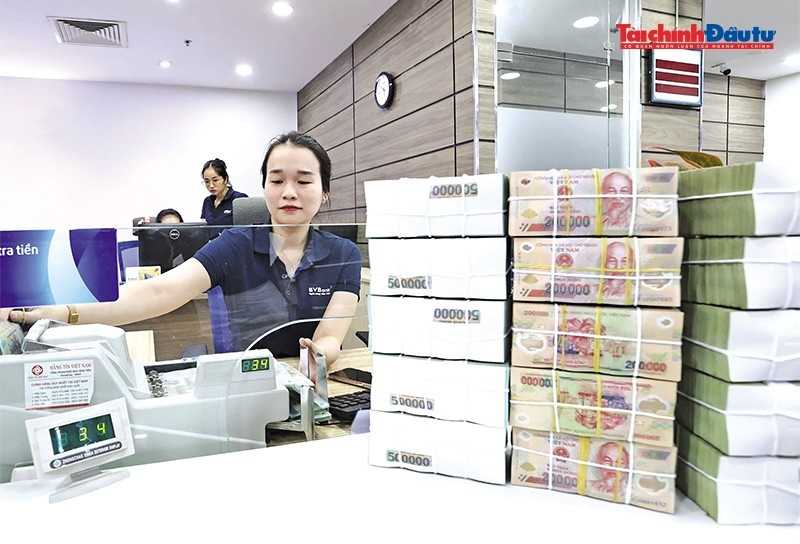
Photo: baodautu.vn
In the third quarter, many banks are forecast to continue posting profit growth. Behind these headline gains, however, lies mounting pressure from higher deposit rates, which are eroding the banking sector’s net interest margin (NIM).
Do Minh Trang, director of Market Analysis and Strategy at ACB Securities Co., Ltd. (ACBS), pointed out that many people tend to believe that a high-interest-rate environment enables banks to make more money.
“In practice, however, a high interest-rate environment carries several adverse implications,” he said.
Trang made the remarks at ACBS’ the online section ‘Data Talk-Market Inside” in Hanoi on September 25.
She noted that deposit rates at many banks for six- to 12-month terms currently hover at 9 per cent or higher. The underlying cause stems from the effects of three years of strong credit growth, which has pushed the loan-to-deposit ratio (LDR) for VND deposits to a record 110 per cent.
The imbalance between deposits and lending, coupled with a shortage of long-term funding, has forced banks to raise deposit rates for longer maturities to retain funds.
Most customer deposits are concentrated in short-term maturities of less than one year, with 70 per cent in the three- to six-month range, while deposits with maturities of more than 12 months account for only 15-20 per cent. Meanwhile, loans are predominantly medium- and long-term, accounting for as much as 40-50 per cent at many banks.
This means banks’ interest expenses on deposits are rising rapidly and continuously, while the time required to reprice existing loans is considerably longer.
“High interest rates and an LDR reaching 110 per cent mean costs are rising faster than interest income, causing NIM to decline. The banking system’s NIM is now only around 2.9 per cent, the lowest level in 10 years. This shows that rapid growth in credit or total assets does not necessarily mean banks are generating higher profits,” Trang said.
Sharing the same view, senior financial expert Nguyen Tri Hieu told VIR that bank deposits are growing relatively quickly, but rising interest rates are also putting banks under significant pressure from funding costs.
“When input costs rise sharply while banks continue to face pressure to maintain reasonable lending rates to support the economy’s growth targets, net interest margins and profitability will be squeezed if operating costs are not properly controlled,” he said.
Echoing concerns over the impact of high funding costs on banking sector profitability, a Q3/2026 review report released by MBS Research on September 25 said that the sector-wide NIM in the third quarter of 2026 is under pressure from elevated funding costs, particularly among joint-stock commercial banks with rapid credit growth or greater reliance on term deposits.
Specifically, in light of the report, at HDBank, the NIM is forecast to reach 4.7 per cent in Q3 of 2026, 19 basis points higher on-year, although the NIM for the first nine months of 2026 is estimated to have fallen by 76 basis points on-year.
Provisioning expenses are expected to rise 23.2 per cent on-year and 10 per cent on-quarter.
At Techcombank, thw NIM is forecast to remain at 3.7 per cent in Q3, unchanged from Q2, but down 17 basis points on-year.
Provisioning expenses are forecast to fall 13.1 per cent on-year but double on-quarter due to a low base.
Third-quarter 2026 pre-tax profit is forecast at $388 million, broadly flat on-quarter, and up 17.5 per cent on-year.
VPBank is also facing funding cost pressures, with NIM forecast to continue declining in Q3 of 2026, down 29 basis points on-year.
Its risk provisioning expenses are forecast at $312 million in Q3, up 19 per cent on-year. VPBank’s Q3 pre-tax profit is expected to reach $466 million.
At LPBank, Q3’s NIM is forecast to decline due to pressure from funding costs. Accordingly, net interest income is expected to edge down during the period, whereas the bank’s non-interest income is expected to grow on-year, mainly driven by net fee income.
Its provisioning expenses are expected to rise by around 40 per cent as asset quality is forecast to continue deteriorating in Q3 of 2026.
In terms of asset quality, MBS Research said that bad-debt pressure in Q3 remains concentrated mainly among small and medium-sized enterprise customers and retail borrowers facing high interest rates, particularly at privately owned joint-stock commercial banks.
Banks step up HSX listings to support capital growth
A growing number of banks are set to move to the Ho Chi Minh City Stock Exchange or debut on the Unlisted Public Company Market in the second half of 2026 as they pursue capital expansion and broaden investor access.
Banks face growing bad debt risks amid rising funding costs
Banks are facing rising bad debt risks as non-performing and special-mention loans increase, while thinner provisioning buffers and higher funding costs threaten to put pressure on asset quality.
Banks roll out lower-cost credit to boost businesses and priority sectors
Banks are stepping up lending rate cuts and rolling out large preferential credit packages, signalling stronger efforts to ease borrowing costs and support businesses and economic growth.
Funding and asset quality to sharpen divide across Vietnam’s banks
Vietnam’s banking sector is entering the second half with the gap between stronger and weaker lenders widening, as funding costs, liquidity pressures and asset quality increasingly separate banks with resilient balance sheets from those reliant on more expensive and short-term funding.
